PLAYBOOK
Multi-Currency Accounts and a Unified Crypto-Fiat Ledger
A practical guide to multi-currency accounts and a unified crypto-fiat ledger: how they work, how to open one, cut FX and fees, and connect your ERP via API.
 By Lucía 11 min read
PLAYBOOK
A practical guide to multi-currency accounts and a unified crypto-fiat ledger: how they work, how to open one, cut FX and fees, and connect your ERP via API.
By Lucía 11 min read A company that sells into three countries usually ends up with three banking relationships, three sets of fees, and a reconciliation process that runs on spreadsheets and hope. Every payout to a supplier in another currency becomes a small project. Every month-end close involves stitching statements from separate systems that were never meant to talk to each other.
A multi-currency account exists to collapse that mess into one. This guide explains what a multi-currency account is, how it works, how to open one, and how to wire it into your accounting and ERP through an API, with comparison tables and a realistic look at fees, coverage and controls. It is written for teams evaluating infrastructure, so it stays vendor-neutral and specific.
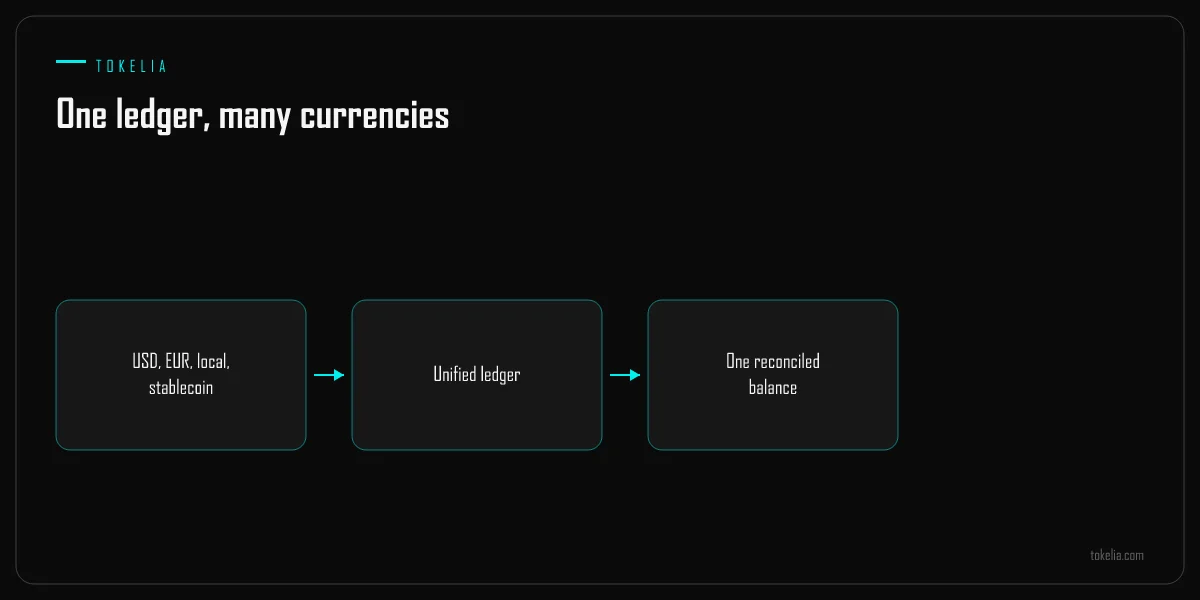
A multi-currency account lets you hold, send and receive money in several currencies from a single account, instead of opening a separate account per currency. Each currency sits in its own sub-balance, and you convert between them when you choose rather than being forced to convert on the way in.
In practice that means a business can invoice a US client in USD, pay a European contractor in EUR, and settle a supplier in a local Latin American currency, all from one place. The account holds the currency you receive until you decide what to do with it, so you are not paying a conversion fee every time money moves. For a deeper look at how these balances sit inside a payment platform, see our guide on how to build a crypto and fiat payment platform.
One account groups several currency sub-balances under a single relationship and a single ledger. Money lands in the matching currency, sits there, and converts only when you initiate it.
The mechanics come down to four layers:
The unified ledger is the part that matters most for a business. When crypto and fiat live on one ledger rather than two disconnected systems, a conversion from a local currency to a stablecoin, or a stablecoin payout back to fiat, is a single recorded movement instead of a manual bridge. That is the same principle behind on-ramp and off-ramp flows: one continuous rail, not two systems glued together per transaction.
Both share the same core mechanics. The difference is in controls, limits and integrations. A personal account optimizes for one person spending and receiving abroad; a business account adds the governance and automation a company needs.
| Feature | Personal account | Business account |
|---|---|---|
| Onboarding | Individual KYC | Company KYB plus beneficial owners |
| Users | Usually one holder | Multiple users with roles and approvals |
| Payouts | Individual transfers | Bulk payouts to suppliers, staff, marketplaces |
| Limits | Consumer-level | Higher, configurable per team |
| API and ERP | Rarely | REST API, webhooks, idempotency for ERP integration |
| Local collection details | Sometimes | Local details (CLABE, IBAN, ACH) where supported |
If your use case involves paying counterparties and closing books, you want the business tier. The rest of this guide assumes a B2B context.
Opening is typically a fully digital onboarding, no branch visit, with identity and compliance checks built into the flow. For a business, you verify the company and its beneficial owners, not just a single person.
A typical checklist for a business account in Latin America:
These checks are not friction for its own sake. Identity verification (KYC/KYB), sanctions and politically-exposed-person screening, and transaction monitoring are how a regulated account stays open. For how these controls run at onboarding and on every transfer, see how KYC and AML work for crypto and fiat payments. Exact document lists vary by market, so confirm the current requirements for each country before you start.
The headline saving is not a single lower fee; it is avoiding conversions you never needed. Holding each currency in its own sub-balance means you convert once, when you choose, instead of on every inbound and outbound payment.
Conversion cost usually takes the form of a spread (a markup) on a reference exchange rate, sometimes with a separate percentage fee. The important habit is to compare the all-in cost, rate plus fees, rather than a single advertised number.
| Cost driver | Traditional cross-border banking | Multi-currency account |
|---|---|---|
| FX markup | Often hidden inside the rate | Shown as a spread before you confirm |
| Forced conversion | Frequently on arrival | Only when you initiate it |
| Receiving abroad | International wire fees | Local details where supported |
| Intermediary (correspondent) fees | Common, hard to predict | Reduced or avoided on local rails |
| Reconciliation effort | Manual across statements | One ledger, one event stream |
Two caveats. First, exchange rates move, so holding a currency carries FX risk: a balance in another currency can gain or lose value against your home currency, and you should manage that deliberately rather than by accident. Second, “free” accounts usually recover cost in the FX spread, so read the conversion terms, not just the monthly fee.
Coverage varies widely between providers, so treat currency and country counts as a checklist item, not a given. Some accounts support a dozen currencies; others advertise 30, 40 or more, with payout reach into a much larger number of countries.
What actually matters for a business is not the raw count but whether the specific corridors you use are covered:
Stablecoins are what let a multi-currency account reach beyond the currencies a single banking partner supports. Settling a cross-border movement in a stablecoin and paying out to local rails can cover corridors that traditional banking treats as exotic. For the trade-offs, see adding stablecoin payments to your fintech.
A multi-currency card lets you spend directly from your balances, drawing on the matching currency where possible so you spend like a local abroad instead of paying a conversion on every purchase. When the card spends from the same unified balance as the rest of the account, there are no separate pre-funding pools to manage.
The design choice that matters is that the card draws on the real-time balance, with per-transaction and per-user limits, freeze controls and 3-D Secure. If you are evaluating card programs, card issuing that spends from a crypto or fiat balance covers how the wallet connects to the card network.
This is where a business account earns its keep. A modern multi-currency account exposes a REST API, webhooks and idempotency keys so your ERP can create accounts, read balances, initiate conversions, and receive an event for every movement. You reconcile from the event stream instead of manual statements.
The pattern is straightforward: your accounting system holds a ledger entry per currency sub-balance, and each webhook event maps to a transaction in that ledger. Idempotency keys ensure a retried request never creates a duplicate movement, which is what keeps an automated ledger trustworthy.
Here is an illustrative request to initiate a conversion between two sub-balances. It shows the shape of a typical call, not any specific product’s exact schema.
curl -X POST https://api.example.com/v1/accounts/acct_123/conversions \
  -H "Authorization: Bearer $API_KEY" \
  -H "Idempotency-Key: conv-2026-07-25-0001" \
  -H "Content-Type: application/json" \
  -d '{
    "from_currency": "MXN",
    "to_currency": "USDC",
    "amount": "50000.00",
    "quote_lock": true,
    "reference": "supplier-invoice-8842"
  }'
A well-designed API returns a locked quote (rate and fee) before the conversion settles, and fires a webhook when it completes, so your ERP records the exact rate applied. Always validate the whole flow in a sandbox before going live, and reconcile against the webhook stream, not a nightly export.
There is no single best multi-currency account; there is the best fit for your corridors, controls and integration needs. Compare on the dimensions that are hard to change later, not just the monthly fee.
A practical evaluation checklist:
Get the FX terms, the custody model and the regulatory backing in writing, and confirm the regulated specifics with counsel. These are the parts you cannot patch after you have scaled.
Holding balances in several currencies is convenient, but it is also a small open FX position. If you keep a large balance in a currency you do not spend, its value against your home currency will drift. Decide deliberately how much to hold in each currency and convert on a policy, not on impulse. This is operational treasury, not investment advice; if you need a currency strategy, work it out with a qualified advisor.
Tokelia provides multi-currency virtual accounts as part of its infrastructure for programmable money: named per-user accounts in USD, EUR, GBP and local Latin American currencies, with real bank details where the market supports them and auto-conversion to stablecoin, all on one unified ledger behind a single REST API with webhooks and idempotency. Cross-border payments settle in stablecoin with FX built in and pay out to local rails, and the whole stack runs on a non-custodial architecture with compliance in the base layer. Money services are provided by Tokelia LLC, registered as a Money Services Business with FinCEN, with regulated banking delivered by licensed institutions, so you can offer multi-currency accounts under your own brand without holding customer funds.
If you are scoping multi-currency accounts for your product or your business, the fastest way to pressure-test the fit is to walk a real flow with our team. Talk to us and we will map it to your corridors and your ERP.
A multi-currency account lets you hold, send and receive money in several currencies from a single account, instead of opening a separate account per currency. Each currency usually sits in its own sub-balance, and you convert between them on demand. For businesses, it means collecting, paying and reconciling across markets without a bank account in every country.
One account groups several currency sub-balances (for example USD, EUR, GBP and local Latin American currencies) under a single relationship and ledger. Money can land in local rails where they exist, sit in the matching currency, and convert to another currency or a stablecoin when you choose. A unified ledger records every balance and movement in one place so reconciliation stays consistent across currencies.
Modern providers expose a REST API, webhooks and idempotency keys so your ERP can create accounts, read balances, initiate conversions and receive an event for every movement. You map each currency sub-balance and transaction to a ledger entry in your accounting system, and reconcile from the webhook stream rather than manual statements. Always test the flow end to end in a sandbox before going live.
Business onboarding typically requires identity verification of the company and its beneficial owners (KYB), plus AML screening for sanctions and politically exposed persons, and ongoing transaction monitoring. Common documents include a government ID for signatories, proof of the company's tax status and proof of address. Exact requirements vary by market and provider, so confirm the current list for each country you operate in.
Where the market and the licensed institutions behind the rails allow it, a multi-currency account can issue local details so you receive payments as a local rather than through slow international wires. That can include CLABE in Mexico, IBAN for European transfers and ACH details in the US. Availability is set market by market, so check which local details are live for the countries you need.
Conversion cost is usually a spread (markup) added to a reference exchange rate, sometimes with a separate percentage fee, and providers should show the rate and fee before you confirm. This tends to be more transparent than traditional banking, where the markup is often buried in the rate. Always compare the all-in cost, rate plus fees, not a single headline number.
How funds are held depends on the model: in a custodial setup the provider holds them and safeguarding rules apply, while in a non-custodial setup the user keeps control and approves every movement. Regulation depends on the provider's registrations and the licensed institutions behind each rail; a multi-currency account provider is not necessarily a bank. Ask directly how funds are held, who is regulated, and confirm the specifics with counsel.
A personal account is built for an individual's spending, travel and receiving money abroad, usually with a single holder. A business account adds company onboarding (KYB), multiple users with roles and approvals, higher limits, bulk payouts to suppliers and staff, and API access so it plugs into your ERP. The core multi-currency mechanics are the same; the controls, limits and integrations differ.
Topics
Written by
LucíaCompliance & Regulatory
Lucía covers compliance and regulation at Tokelia. She writes about the licensing, KYC/AML and travel-rule questions that come up when a fintech starts moving crypto and fiat, and turns them into decisions a founding team can act on.
Tell us your use case and we’ll point you to the right layer: infrastructure, tokenization or Yakopay.
We use essential cookies to run this site and, only with your consent, analytics cookies to measure traffic. You can change your choice anytime. Cookie Policy