EXPLAINER
What Is Banking-as-a-Service (BaaS)? A Practical Guide
A clear guide to banking as a service (BaaS): what it means, how the API model works, its benefits, and how it differs from open banking and embedded finance.
 By Lucía 10 min read
EXPLAINER
A clear guide to banking as a service (BaaS): what it means, how the API model works, its benefits, and how it differs from open banking and embedded finance.
By Lucía 10 min read A retailer wants to give shoppers a branded card. A marketplace wants to pay thousands of sellers across borders on the same day. An HR platform wants to run payroll accounts without becoming a bank. None of them want to spend three years chasing a banking license.
Banking-as-a-Service is what makes those launches possible. It turns regulated banking into infrastructure you consume through an API, so you can put accounts, cards and payments inside your own product without building a bank from scratch. This guide explains what BaaS is, how the model works, what you can build with it, and how it differs from the terms it gets confused with: open banking, embedded finance and traditional banking.
Banking-as-a-Service (BaaS) is a model in which a licensed financial institution exposes its regulated banking functions through an API, so a non-bank company can offer accounts, cards and payments under its own brand. The regulated activity stays with the licensed institution; the brand owns the product and the customer relationship.
The term breaks into two halves. “Banking” is the regulated capability: holding balances, moving money, issuing cards, running the checks a regulator expects. “As a service” means you rent that capability on demand through software, the same way you rent compute or storage from a cloud provider, instead of building and licensing it yourself.
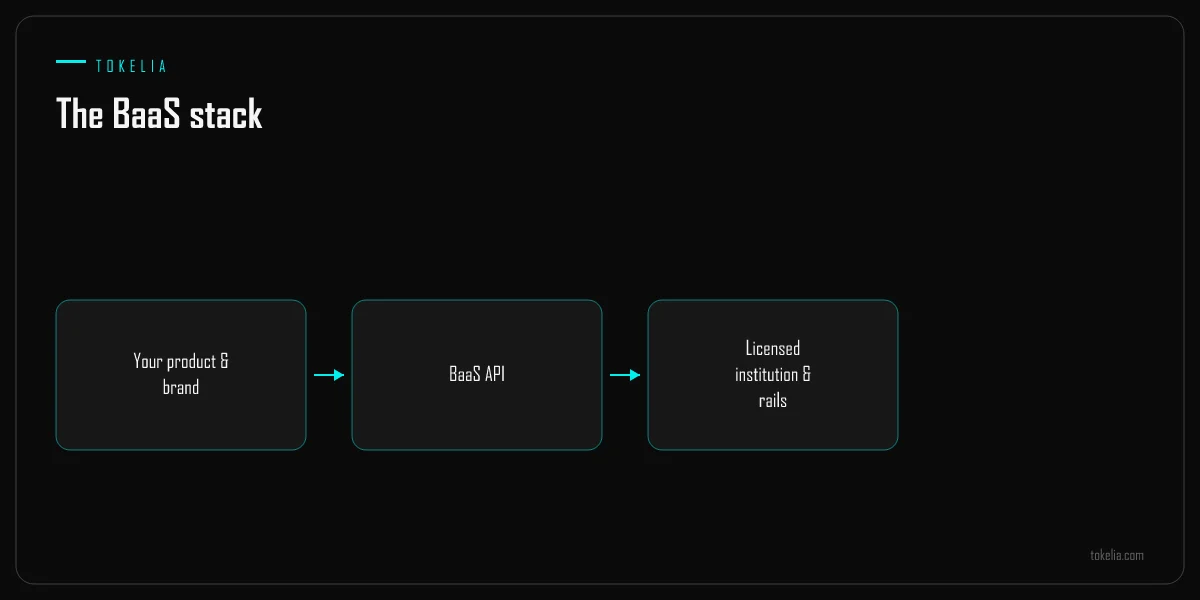
The practical effect is a split of labor. You build the experience your customers see and the logic that makes your product distinctive. A licensed institution, connected through a BaaS platform, provides the rails and carries the regulated weight. You ship a financial product in weeks instead of years.
At its core, BaaS is banking infrastructure delivered as API endpoints. Every capability (open an account, issue a card, send a payment, screen a customer) is a call your engineers make, with webhooks pushing events back to your system in real time.
This matters because it changes what your team actually does. Instead of negotiating with a bank’s operations desk or exchanging files overnight, your product talks to the rails programmatically. A well-built BaaS API includes the things production systems need: sandbox environments to test against, idempotency so a retried request never double-processes a payment, and webhooks so your ledger stays in sync with every transaction event.
The API model is also what makes BaaS composable. You take only the endpoints you need, wire them into your existing product, and add more over time without re-architecting. A team can launch with accounts and payouts, then add cards and cross-border transfers later, all against the same surface.
A BaaS arrangement almost always involves three parties: the licensed institution, the BaaS platform, and the brand. Understanding who does what is the fastest way to understand the model.
The licensed institution holds the regulatory permissions. It is the bank or regulated entity whose license makes the accounts, card programs and money movement lawful. It carries the heaviest compliance obligations and sits at the base of the stack.
The BaaS platform is the layer that turns those regulated capabilities into developer-friendly APIs, dashboards and tooling. It handles the integration work, orchestrates one or more licensed partners, and packages compliance controls so the brand does not have to assemble them piece by piece.
The brand is the company customers actually see: a fintech, a marketplace, a retailer, a bank modernizing its stack, or an AI platform. It designs the experience, owns the customer relationship, and decides which financial features to embed.
Some providers combine the platform and the licensed layer into one offering. Others act as an orchestration layer over several licensed partners, routing each function to the right one. Either way, the brand integrates against a single API instead of stitching together a bank, a card processor and a compliance vendor separately.
BaaS works by letting you assemble a financial product from modular building blocks, each exposed as an API, with the regulated activity handled behind them. You are not buying a fixed package; you are composing the exact product you need.
The typical building blocks look like this:
| Building block | What it does | Example in a product |
|---|---|---|
| Digital accounts | Named accounts with real bank details, sometimes multi-currency | A payroll balance for each employee |
| Card issuing | Virtual or physical cards that spend from a balance | A branded debit card for shoppers |
| Payments and payouts | Domestic and cross-border transfers over bank and card rails | Same-day payouts to marketplace sellers |
| Onboarding and KYC | Identity verification and screening inside signup | A regulated account opened in one flow |
| Lending | Credit lines or installment products where the partner supports them | Buy-now-pay-later at checkout |
You call the endpoint, the licensed institution performs the regulated action, and a webhook confirms the result. The compliance checks (identity verification, sanctions screening, transaction monitoring) run inside these flows rather than as a separate project you bolt on afterward. That embedded compliance is a large part of what you are paying for, and it is one of the hardest things to build well on your own.
For a deeper look at how these pieces fit into a full product, see our guide on how to build a crypto and fiat payment platform, which walks through the day-one foundations in detail.
The core benefit of BaaS is speed to market without the cost and risk of becoming a bank. A team that would need years to obtain a license and build rails can launch a regulated financial product in weeks by consuming that capability through an API.
The benefits stack up in a few clear ways:
The trade-off is honest: you depend on your provider and its licensed partners, and you still carry real compliance responsibilities. BaaS moves the heavy regulated work off your plate; it does not make compliance disappear. The exact obligations vary by market, so map your perimeter with counsel before you scale.
BaaS and open banking are frequently confused because both involve banks, APIs and third parties, but they solve different problems. Open banking shares access to accounts that already exist; BaaS lets you create and run new accounts under your own brand.
Open banking, driven by regulation in many markets, lets a customer grant a third party permission to read their bank data or initiate a payment from an account they already hold. It is about connectivity to existing relationships. BaaS is about origination: standing up the account, card or payment product itself.
| Dimension | Open banking | Banking-as-a-Service |
|---|---|---|
| Core purpose | Access and share existing account data | Create and operate new financial products |
| What you get | Read balances, initiate payments from existing accounts | Issue accounts, cards, payments under your brand |
| Who holds the product | The customer’s existing bank | You, on a licensed partner’s permissions |
| Typical driver | Regulation mandating data access | Commercial infrastructure and speed to market |
| Example | A budgeting app reading transactions across banks | A marketplace issuing its own seller accounts |
A simple way to keep them straight: open banking connects to the bank you already use, while BaaS lets you become the place where the account lives.
BaaS is the infrastructure; embedded finance is the experience it enables. Embedded finance describes financial features living naturally inside a non-financial product, and BaaS is one of the main ways to deliver them.
When a ride-hailing app offers drivers an instant-pay debit card, that card is embedded finance. The accounts, card issuing and payout rails underneath it are almost certainly BaaS. One is the outcome the customer feels; the other is the plumbing that makes it real.
Which model accelerates a launch? They are not alternatives, so the real question is whether your BaaS provider covers the building blocks your embedded experience needs. The more of them (accounts, cards, payments, onboarding, compliance) that live behind one API, the faster you ship, because you integrate once instead of assembling a different vendor for each piece. If you are weighing where value moves in these systems, our note on multi-currency accounts and a unified ledger shows why a single balance layer matters underneath.
BaaS and traditional banking use the same underlying capabilities but sell them in opposite directions. Traditional banking offers financial products directly to end customers under the bank’s own brand; BaaS turns those capabilities into infrastructure that other companies consume and rebrand.
In the traditional model, the bank owns the license, the product, the channel and the customer. In the BaaS model, the licensed institution steps back to become the regulated engine, while a brand it may never meet in person builds the front end and owns the relationship.
| Dimension | Traditional banking | Banking-as-a-Service |
|---|---|---|
| Who serves the customer | The bank, directly | A brand, powered by the bank |
| Brand on the product | The bank’s | The brand’s own |
| Distribution | The bank’s branches and channels | Any product that integrates the API |
| Speed to launch a feature | Slow, internal roadmap | Fast, an API call away |
| Role of the license | Front-end and back-end | Back-end engine only |
Neither model replaces the other. Traditional banks increasingly power BaaS themselves, using it to reach customers and segments their own channels never would.
BaaS removes most of the heavy lifting, but it is not a way to opt out of responsibility. A few things deserve honest attention before you commit.
You still own compliance in your product. KYC/AML, consumer protection, data handling and fair treatment of customers remain your obligations even when a partner runs the checks. For how these controls work in practice, see our guide on how KYC and AML work for crypto and fiat payments.
You take on provider dependency. Your product runs on someone else’s rails and licenses, so choose a provider whose coverage, reliability and roadmap match yours, and understand what happens if a partner relationship changes. Coverage is set market by market, not global by default, because it follows the licensed institutions behind each rail.
Finally, custody and licensing shape your risk profile more than any feature does. Whether you hold customer funds, and on whose license you operate, drives your entire regulatory perimeter. Those questions are worth settling early with counsel, and the specifics vary by market.
Tokelia is Banking-as-a-Service for programmable money: virtual accounts, unified crypto-and-fiat rails, card issuing, cross-border payments and stablecoins, behind one API, with a non-custodial architecture and compliance built into the base stack. Money services are provided by Tokelia LLC, registered as a Money Services Business with FinCEN, with regulated banking delivered by licensed institutions, so you launch under your own brand while the hard-to-change parts are already solved.
The developer surface is what you would expect from production infrastructure: a REST API, SDKs, webhooks and idempotency, with a sandbox to build against. And because the model is non-custodial, your users keep control of their own funds, which changes both the security and the regulatory picture in your favor. You can read more on that trade-off in custodial vs non-custodial: which custody model to choose.
If you are scoping a product and want to see how BaaS maps to your use case, talk to our team and walk a real flow end to end.
Banking-as-a-Service (BaaS) is a model where a licensed institution exposes its regulated banking functions (accounts, payments, cards) through an API, so a non-bank company can offer those features inside its own product. The brand builds the customer experience while the licensed institution and the BaaS platform handle the regulated activity and much of the compliance work behind the scenes.
Open banking is about reading and sharing existing bank data (with the customer's consent) so a third party can see balances or initiate a payment from an account the customer already holds. BaaS is about creating and running new financial products (accounts, cards, payouts) under your own brand. Open banking connects to accounts that already exist; BaaS lets you issue the accounts themselves.
Usually not for the parts a licensed partner covers. The point of BaaS is that the regulated activity is delivered by licensed institutions, so you can operate on their permissions for those functions. You still carry your own compliance obligations (KYC/AML, consumer protection, data), and your exact perimeter depends on your product and markets, so confirm it with regulatory counsel.
They are related but not identical. Embedded finance is the outcome (financial features living inside a non-financial product, like paying or borrowing at checkout). BaaS is one of the main ways to deliver that outcome, providing the regulated rails and APIs underneath. You can think of BaaS as the infrastructure and embedded finance as the experience it powers.
Common products include digital accounts with real bank details, debit or prepaid cards, domestic and cross-border payments, payouts, and user onboarding with identity checks built in. Some platforms also cover lending, multi-currency balances and stablecoin rails. The building blocks are exposed as API endpoints so you assemble the product you need rather than buying a fixed package.
Traditional banking sells financial products directly to end customers under the bank's own brand and channels. BaaS turns those same capabilities into infrastructure that other companies consume through an API and offer under their brand. The bank moves from being the front-end provider to being the licensed engine behind many third-party products.
There are usually three: the licensed institution that holds the regulatory permissions, the BaaS platform that exposes those capabilities as developer-friendly APIs and tooling, and the brand (a fintech, marketplace, bank or AI platform) that builds the product customers see. Some providers combine the platform and licensed layers; others orchestrate multiple licensed partners behind one API.
Topics
Written by
LucíaCompliance & Regulatory
Lucía covers compliance and regulation at Tokelia. She writes about the licensing, KYC/AML and travel-rule questions that come up when a fintech starts moving crypto and fiat, and turns them into decisions a founding team can act on.
Tell us your use case and we’ll point you to the right layer: infrastructure, tokenization or Yakopay.
We use essential cookies to run this site and, only with your consent, analytics cookies to measure traffic. You can change your choice anytime. Cookie Policy