PILLAR
Real-world asset (RWA) tokenization: the complete guide
Real world asset tokenization explained in plain business terms: how it works, what you can tokenize, the compliance stack, and why Latin America fits.
 By Daniel 13 min read
PILLAR
Real world asset tokenization explained in plain business terms: how it works, what you can tokenize, the compliance stack, and why Latin America fits.
By Daniel 13 min read Real world asset tokenization is the process of representing ownership or economic rights in a physical or financial asset, such as a building, an invoice, a private credit fund, or a stake in a commodity, as a digital token on a blockchain. The token does not replace the legal claim to the asset; it represents it, carries it, and enforces the rules that decide who is allowed to hold it.
For a founder or finance leader, the appeal is practical rather than ideological. Assets that used to sit still for months, such as a commercial building or a pool of invoices, can now be split into smaller units, transferred in minutes instead of weeks, and distributed to investors who were previously out of reach. This guide is the starting point for a full series on the topic: it covers what tokenization is, what can be tokenized, how the lifecycle works end to end, the infrastructure stack behind it, the compliance reality, and why Latin America is a natural place to build first.
Strip away the blockchain language and tokenization is a distribution mechanic. An asset that generates cash flow (rent, invoice payments, loan interest, fund returns) gets wrapped in a legal structure, and instead of selling shares of that structure through a slow, paper-heavy process, the issuer sells tokens that represent those shares. The token is a record of ownership and a settlement rail at the same time.
This matters because the constraints that make illiquid assets illiquid are mostly operational, not fundamental. A building is not hard to sell because nobody wants a piece of it; it is hard to sell because assembling a syndicate of investors, running legal paperwork per investor, and settling transfers takes months and a small army of intermediaries. Tokenization does not remove the legal work, but it automates the parts that are repetitive: identity checks, eligibility rules, transfer restrictions, and distribution of cash flows.
The business case rests on five concrete benefits, and they compound with each other rather than standing alone.
Liquidity for illiquid assets. Real estate, private credit and receivables historically trade in large, infrequent blocks because the transaction cost of a smaller trade is too high. A token can represent a fraction of the asset, and a compliant secondary market lets holders exit before maturity instead of waiting years.
Fractional ownership. Splitting a single asset into thousands of tokens lowers the minimum ticket size, which opens the investor base beyond institutions with seven-figure allocations to family offices, smaller funds and, where regulation allows, qualified individual investors.
Faster, closer to 24/7 settlement. Traditional securities settlement runs on batch cycles measured in days. A blockchain-based transfer settles in minutes and does not wait for a business day to open in a specific time zone, which matters for a platform serving investors across several countries at once.
Programmable compliance and distributions. Transfer restrictions, holding periods and eligibility rules can be enforced in the token itself rather than through a manual back office, and cash flow distributions (rent, interest, dividends) can be automated to the wallet holding the token at the time of the distribution.
Access to global investors. A well-structured offering can reach investors outside the issuer’s home market without building a separate distribution relationship in every country, subject to the securities rules that apply in each jurisdiction.
None of these benefits are automatic. They depend on the legal wrapper being sound, the compliance layer being enforced on every transfer rather than only at onboarding, and the banking rails behind the token actually working, which is why the rest of this guide walks through the lifecycle and the stack in detail rather than stopping at the pitch.
Tokenization works best on assets that already produce a predictable, documentable cash flow or a clear title of ownership. Five categories account for most of the activity today.
Real estate. Commercial and residential property is the most intuitive case: rental income becomes a distribution, and a stake in the property becomes a token. We cover the mechanics end to end in how to tokenize real estate.
Invoices and receivables. A company waiting 60 or 90 days to get paid can sell that receivable to investors today, and the repayment becomes the token’s cash flow. See tokenized invoice factoring for how this works as a liquidity product.
Private credit. Loans that would otherwise sit on a single lender’s balance sheet can be fractionalized and distributed to a pool of investors, with interest payments flowing through the token structure.
Investment funds. Fund shares that are normally sold through a subscription document and a transfer agent can be issued as tokens, which simplifies subscription, redemption and secondary transfer for the fund’s investor base.
Commodities. Physical commodities held in custody (metals, agricultural stock) can be represented as tokens backed by verified inventory, giving investors exposure without direct physical handling.
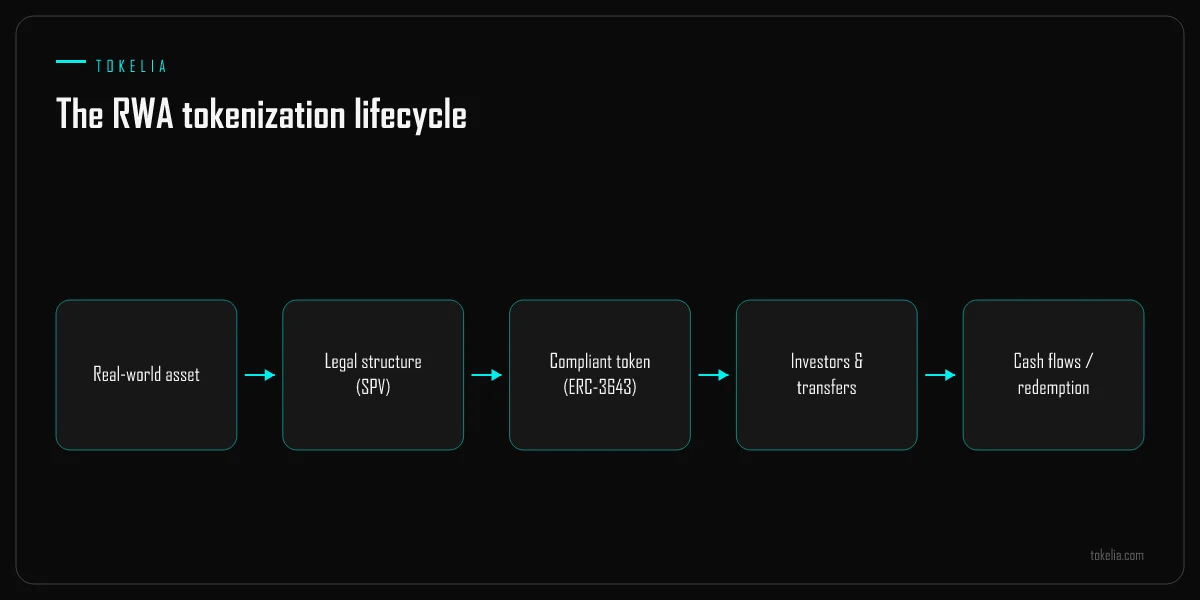
Every tokenized asset moves through the same sequence, regardless of asset class. This is the structure the figure above illustrates: an asset becomes a legal claim, the legal claim becomes a compliant token, and the token moves only between verified holders while generating cash flows back to them.
| Stage | What happens | Infrastructure it needs |
|---|---|---|
| Asset | The underlying asset (property, invoice pool, loan, fund, commodity) is identified, valued and documented | Legal and financial due diligence, valuation, custody of the physical or contractual asset |
| Legal wrapper (SPV) | The asset is placed in a special purpose vehicle that actually holds title, and the SPV issues rights against itself | Corporate formation, securities counsel, offering documents |
| Compliant token | The SPV’s shares or notes are represented as tokens, typically on a permissioned standard such as ERC-3643 | Issuance engine, smart contracts, an on-chain identity and compliance layer |
| KYC-verified investors | Investors complete identity verification and eligibility checks before they can receive tokens | KYC/KYB provider, sanctions and accreditation screening, an on-chain identity record |
| Transfer restrictions | Every transfer is checked against eligibility and jurisdiction rules before it settles | A compliance contract that approves or blocks transfers in real time |
| Cash flows and redemption | Rent, interest, invoice repayments or fund distributions are paid out to current token holders, and the token can be redeemed at maturity or exit | Banking rails for fiat in and out, a distribution engine, reporting for issuer and investors |
The stage worth dwelling on is the legal wrapper. The token is never a substitute for the SPV; it is a representation of rights against it. Skipping or under-documenting this step is the single most common way tokenization projects run into trouble, because a technically well-built token with a weak legal claim behind it is still a weak claim.
Running a tokenization program end to end requires several pieces of infrastructure working together, not a single smart contract deployment. Most issuers underestimate this the first time they scope a project.
Teams that want the full picture of standing up this stack under their own brand should read how to launch a white-label tokenization platform.
The pieces above rarely come from one vendor, which is precisely the problem. An issuance engine without a real banking connection cannot pay out redemptions in fiat. Identity and compliance infrastructure without an investor portal leaves your operations team doing manual reconciliation. The teams that ship a working program treat this as one integrated stack, not a collection of point solutions stitched together after the fact.
Tokenized real-world assets are usually securities, and treating them otherwise is the fastest way to build something that cannot legally operate. Because the token represents ownership or a claim on cash flows, most jurisdictions that regulate this activity apply securities law to it: registration or exemption requirements, disclosure obligations, and restrictions on who can buy and how the offering can be marketed.
That has three practical consequences. First, KYC and AML are not optional add-ons; they are the mechanism that keeps ineligible or sanctioned parties out of the token, and they need to run at onboarding and on every transfer, not once. Second, jurisdiction matters at both ends: where the issuer is formed and where each investor is located both affect which rules apply, and a single global offering rarely clears every market the same way. Third, disclosure is not just a legal formality; investors need accurate, current information about the underlying asset to make an informed decision, and inaccurate disclosure is a liability regardless of the technology used to distribute the security.
It is worth being direct about the boundary here: none of this is legal or investment advice, and this guide does not make claims about specific countries’ laws. If you are structuring a tokenized offering, work with securities counsel in every jurisdiction you plan to sell into before you issue a single token.
For the related question of how a token’s economic design changes its regulatory treatment, see security tokens vs utility tokens.
Latin America has a specific combination of conditions that makes it a strong starting point for real-world asset tokenization rather than an afterthought.
Dollarization and access to global capital matter in economies where local currency volatility pushes both issuers and investors toward dollar-denominated instruments. A tokenized offering that settles in a stablecoin or a dollar-denominated wrapper gives investors in the region access to assets and yields that were previously reachable only through offshore accounts, and gives issuers access to capital beyond their home market.
Real estate, agribusiness and receivables are the natural first assets for the region, because they are already well understood by local investors and already generate documentable cash flow. A commercial property in a major Latin American city or a pool of agribusiness receivables does not need an education campaign to explain the underlying asset, only an explanation of the token wrapper around it.
Local payment rails matter for adoption in practice, not just in theory. Investors subscribing to a tokenized offering want to fund it and receive distributions through the rails they already use: PIX in Brazil, SPEI in Mexico, Bre-b or a bank transfer in Colombia. A platform that only accepts wire transfers or crypto on-ramps loses a large share of the addressable investor base before the first token is issued. For the broader case for building fintech and tokenization infrastructure in the region, see our Latin America hub.
The decision to build a tokenization stack in-house versus integrating one comes down to what is actually differentiated about your business. If tokenization is a feature that supports a real estate fund, a receivables desk or a private credit shop, the differentiation is in the asset origination and the investor relationship, not in the smart contract or the KYC flow. Building the compliance and issuance layer from scratch means owning smart contract security, on-chain identity infrastructure, banking relationships and ongoing regulatory maintenance, which is a multi-quarter effort before the first token is ever sold.
If tokenization infrastructure itself is the product (you are building a platform for other issuers to use), the calculation changes, and deep in-house expertise becomes the point. For most operating businesses adding tokenization as a capability, though, integrating existing infrastructure and putting engineering effort into the asset and the investor experience is the faster and lower-risk path. The same logic applies to the banking side of the business: most teams should not build core banking infrastructure to launch a fintech either, which is why banking-as-a-service exists as its own category, and why identity verification is typically handled through a dedicated KYC/AML layer rather than built from scratch.
This pillar connects to the rest of the tokenization series and to the wider infrastructure that supports it:
Tokelia is the full-stack infrastructure to launch a fintech or a tokenization platform in Latin America: virtual accounts, unified crypto-and-fiat rails, local payment rails (PIX, SPEI, Bre-b) alongside ACH, Wire, FedNow, SEPA and FPS, card issuing and real-world asset tokenization, behind one API, with a non-custodial architecture and compliance built into the base stack. Money services are provided by Tokelia LLC, registered as a Money Services Business with FinCEN, and regulated banking is delivered by licensed institutions, so you can launch under your own brand while the hard-to-change parts are already solved.
If you are scoping a tokenization program or a fintech launch, the fastest way to see how the stack maps to your assets and your investors is to talk to us.
Real-world asset tokenization is the process of representing ownership or economic rights in a physical or financial asset, such as real estate, an invoice, a private credit position or a fund share, as a digital token on a blockchain. The token is issued against a legal structure that actually holds the asset, and it carries the rules that decide who can hold and transfer it. It is a new distribution and settlement layer for existing assets, not a new asset class.
In most cases, yes. A token that represents ownership, a share of profits, or a claim on cash flows from an underlying asset typically meets the definition of a security in the jurisdictions that regulate this activity, which means securities law, KYC and AML obligations, and disclosure requirements apply. This is general information, not legal or investment advice; confirm the specific treatment for your asset and jurisdiction with qualified counsel.
The most common categories today are real estate, invoices and receivables, private credit, investment fund shares, and commodities. Each has a different legal wrapper and a different investor base, but the underlying pattern is the same: an asset that already generates or represents value gets a legal structure, a compliant token, and a set of verified investors who can hold and transfer it.
ERC-20 is a permissionless token standard: anyone with a compatible wallet can receive and hold it. ERC-3643 (also known as T-REX) is a permissioned standard built for regulated assets: it ties each token to an on-chain identity through ONCHAINID, checks claims issued by trusted parties such as KYC providers, and runs every transfer through a compliance contract that blocks it if the recipient is not an eligible, verified investor. That difference is what makes ERC-3643 suitable for securities and ERC-20 generally unsuitable.
Yes, in a properly built system. Because tokenized real-world assets are usually securities, investors go through identity verification and screening before they can hold the token, and the compliance layer enforces this on every transfer, not just at initial purchase. This is what lets an issuer stay confident that only eligible investors hold the asset at any point in its life.
For most teams, buying is faster and safer. Issuance engines, on-chain identity and compliance, custody, banking rails and investor portals are undifferentiated, hard to get right, and expensive to maintain in-house. Building makes sense when tokenization is the core product and the team has deep smart contract and securities expertise; otherwise, integrating a platform that already handles the plumbing lets you focus on the asset and the investor relationship.
Topics
Written by
DanielFull-Stack Developer, Tokenization
Daniel is a full-stack developer at Tokelia, working on the tokenization stack. He writes from the build side about how real-world assets move on-chain (real estate, receivables, agribusiness), the standards that keep it compliant (ERC-3643, KYC) and how a team can launch a tokenization platform without building the infrastructure from scratch.
Tell us your use case and we’ll point you to the right layer: infrastructure, tokenization or Yakopay.
We use essential cookies to run this site and, only with your consent, analytics cookies to measure traffic. You can change your choice anytime. Cookie Policy