Every crypto product eventually hits the same wall: users live in fiat. Salaries arrive in pesos, invoices are paid in dollars, and rent is not accepted in stablecoins. The bridge between that fiat world and the on-chain one has a name, and it comes in two directions.
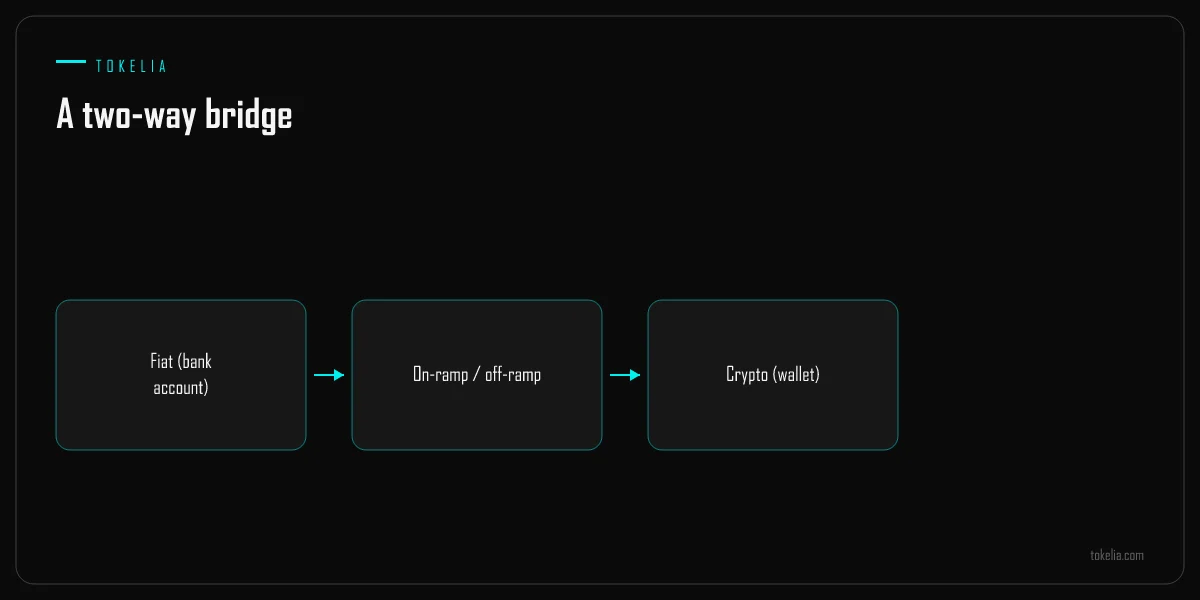
An on-ramp turns fiat into crypto. An off-ramp turns crypto back into fiat. Together they are the plumbing that lets money enter and exit the digital-asset economy without friction. This explainer covers what each one is, how the process works step by step, what it costs, the compliance that sits underneath it, and how a business plugs a ramp into its own product through an API.
What a crypto on-ramp and off-ramp actually are
An on-ramp is any service that converts local currency into crypto or a stablecoin. An off-ramp does the opposite, converting crypto into local currency and settling it to a bank account or card. Both are conversion-plus-settlement engines: they price the exchange, execute it, and move the funds across a payment rail.
The distinction matters because the two directions have different mechanics. An on-ramp starts with a fiat payment (a card charge, a SPEI transfer, an ACH pull) and ends with tokens in a wallet. An off-ramp starts with tokens and ends with a fiat payout, which depends on the destination bank and can take longer to clear.
| On-ramp | Off-ramp |
|---|
| Direction | Fiat to crypto | Crypto to fiat |
| Starts with | Bank transfer, card, local rail | Stablecoin or crypto balance |
| Ends with | Tokens in a wallet | Fiat in a bank account or card |
| Typical use | Funding a wallet, buying stablecoins | Cashing out, paying suppliers, payroll |
| Settlement speed | Seconds to minutes on instant rails | Near-instant to 1 to 2 business days |
Most serious providers expose both directions behind one integration, because a real product needs money to flow in and out, not just one way.
How the on/off ramp process works, step by step
At a high level, a ramp is a sequence of five stages: identity, quote, payment, conversion and settlement. The order is the same in both directions; only the endpoints swap.
For an on-ramp, the flow looks like this:
- Identity. The user (or business) is verified through KYC or KYB before any money moves.
- Quote. The provider prices the conversion, locking an exchange rate and disclosing fees for a short window.
- Payment. The user pays in fiat over a card, a local instant rail or a bank transfer.
- Conversion. Once the fiat clears, it is converted to the chosen crypto or stablecoin at the quoted rate.
- Settlement. The tokens land in the destination wallet, and a webhook confirms the event.
For an off-ramp, reverse it: the user sends crypto, the provider locks a fiat quote, converts, and pays out to the destination bank account or card. The compliance and quoting stages are identical; the difference is which side is fiat and which is on-chain.
The unhappy paths are where quality shows. A good ramp handles rejected payments, expired quotes, chargebacks on card on-ramps, network congestion on-chain, and failed payouts when a bank account is invalid. If you are building on top of one, test those paths before you test the happy one. Our pillar guide to building a crypto and fiat payment platform covers why the failure cases, not the demo, decide whether a stack is production-ready.
Fees, spreads and exchange rates
The true cost of a ramp is almost never a single number. It is usually a percentage fee plus a spread, the small gap between the rate you get and the mid-market rate. Reading only the headline fee is how teams underestimate their real cost.
Three components make up the all-in price:
- The service fee. A percentage of the transaction, sometimes with a fixed minimum on small amounts.
- The FX spread. The margin baked into the exchange rate between fiat and the crypto or stablecoin.
- The network or payout cost. On-chain gas on the crypto side, or a rail fee on the fiat payout side.
| Cost component | On-ramp | Off-ramp |
|---|
| Service fee | Percentage of fiat paid in | Percentage of crypto converted |
| FX spread | Fiat to stablecoin rate | Stablecoin to fiat rate |
| Network cost | Gas to deliver tokens | Usually absorbed in conversion |
| Payout cost | Usually none | Local rail or card payout fee |
Two practical rules. First, always compare the amount the recipient actually receives, not the quoted fee. Second, watch how the spread behaves on volatile assets versus stablecoins; stablecoin ramps tend to have tighter, more predictable spreads, which is one reason many B2B flows settle in stablecoins first and convert at the edges. If stablecoins are new to your roadmap, our guide to adding stablecoin payments to a fintech breaks down the tradeoffs.
KYC/AML and the compliance underneath
A compliant ramp is not just a currency converter with a checkout. It is a regulated flow with identity, screening and monitoring built into every transaction. This is the part that separates a durable provider from one that will be shut off by its banking partner.
The controls that run on a well-built ramp include:
- KYC and KYB verification at onboarding, including beneficial-owner checks for business accounts.
- Sanctions and PEP screening on the parties, refreshed over time, not just at signup.
- Wallet screening on the crypto side, checking counterparty addresses against risk databases.
- Transaction monitoring for structuring, velocity and other suspicious patterns.
- Travel-rule data exchange on qualifying transfers, so originator and beneficiary details travel with the value.
These obligations are general principles, not a fixed checklist, and the exact thresholds and forms vary by market. For a deeper walkthrough, see how KYC and AML work for crypto and fiat payments. Whatever your market, confirm the specifics with regulatory counsel rather than assuming one country’s rules apply everywhere.
On licensing, the honest answer for Mexico and the rest of LatAm is that it depends on who controls the funds. If you custody or transmit money yourself, you generally need money-services authorization in each market you serve. If you operate non-custodially as an agent of licensed institutions, much of the regulated surface can ride on partner licenses while you own the product. The perimeter is set market by market, so map it early.
Supported fiat payment methods in Mexico and LatAm
The value of a ramp depends heavily on the local rails it supports, because users pay with what they already have. In LatAm that means instant bank rails and cards far more than international wires.
| Market | Common on/off ramp rails |
|---|
| Mexico | SPEI instant transfers, debit and credit cards |
| Brazil | PIX instant payments, cards |
| Colombia | PSE bank transfers, cards |
| Regional | Standard bank transfers, cards |
| US corridor | ACH transfers, cards |
| Europe corridor | SEPA transfers, cards |
Coverage differs by provider and by country, and a rail that exists in a market is not the same as a rail your provider actually supports there. Confirm the exact methods for each corridor you plan to serve before you commit to a launch market. Behind the scenes, ramps often route these local rails into a stablecoin so that value can move across borders without correspondent banking, then off-ramp to local fiat at the destination.
API integration: embedding a ramp in your product
For a business, an on/off ramp is usually consumed as an API, not a website. The provider exposes REST endpoints to request a quote, execute a conversion and receive settlement events through webhooks, with idempotency keys so a retried request never double-charges.
A typical on-ramp request is small and readable. Here is an illustrative quote-and-execute call:
POST /v1/onramp/orders
{
  "direction": "fiat_to_crypto",
  "source": { "currency": "MXN", "amount": 5000, "rail": "spei" },
  "destination": { "asset": "USDC", "network": "base", "wallet": "0xA1b2..." },
  "customer_id": "cus_8fk29",
  "idempotency_key": "order-2026-07-30-0001"
}
The response returns an order id, a locked quote with the fee and spread broken out, and a status. Your backend then listens for a webhook (order.settled or order.failed) rather than polling. Off-ramps mirror this: the direction flips to crypto_to_fiat and the destination becomes a bank account or card.
Three integration essentials separate a solid build from a fragile one. Use idempotency keys on every write so retries are safe. Treat webhooks as the source of truth for settlement, and verify their signatures. And reconcile every order against your own ledger, because a ramp that does not reconcile cleanly will fail an audit no matter how nice the API looks.
The build-versus-buy question resolves quickly here. Building your own ramp means sourcing liquidity, banking partners, licenses and compliance tooling, which is slow and capital-heavy. Integrating one gives you working rails in weeks and shifts most of the licensing and liquidity liability onto the partner. Most teams build the experience and integrate the ramp underneath.
Security, custody and keeping funds safe
The safety of a ramp comes down to one question: who holds the money while it moves? In a custodial model the provider holds user funds and keys, which concentrates risk and pulls the provider deep into safeguarding rules. In a non-custodial model users keep control of their own funds and approve each movement, so no customer money sits on the provider’s balance sheet.
Neither model removes the need for controls. Whatever the design, look for auditable fund segregation, real-time traceability of every movement, clear proof-of-reserves and counterparty screening on the crypto side. The custody choice also shapes your regulatory profile, which is why it deserves a deliberate decision rather than a default. If you are weighing the two, our explainer on custodial versus non-custodial custody lays out how the choice flows through to licensing and operations.
Where Tokelia fits
Tokelia provides on/off-ramp and mass payouts as part of its programmable-money infrastructure, over ACH, SEPA, local instant rails and stablecoin, with approvals and receipts on every movement. It runs on a non-custodial architecture, so your users keep control of their own funds, and compliance (KYC/AML, sanctions screening and travel-rule handling) is built into the base stack rather than bolted on. Money services are provided by Tokelia LLC, registered as a Money Services Business with FinCEN, with regulated banking delivered by licensed institutions, so you can embed a ramp under your own brand while the hard parts are already solved.
If you are scoping a ramp for a specific corridor, the fastest way to pressure-test it against your use case is to walk a real flow with our team. Talk to us and get a sandbox key.
 By Lucía 10 min read