HOW-TO
How to tokenize real estate, step by step
How to tokenize real estate, step by step: structure the SPV, issue an ERC-3643 token, onboard KYC-verified investors, and distribute rent to global buyers.
 By Daniel 10 min read
HOW-TO
How to tokenize real estate, step by step: structure the SPV, issue an ERC-3643 token, onboard KYC-verified investors, and distribute rent to global buyers.
By Daniel 10 min read Tokenizing a building used to mean assembling a syndicate of investors, running paperwork property by property, and waiting months to close. Real estate is usually the first asset a team tries when it explores tokenization, because it already produces a documentable cash flow (rent) and a clear legal title. This guide walks through how to tokenize real estate, step by step: structuring the legal wrapper, designing the offering, issuing a compliant token, onboarding verified investors, distributing yield on-chain, and handling exit, along with realistic costs and the risks worth planning for.
This is general information, not legal or investment advice. Tokenized real estate is usually a security, and the specific structure, offering design and token standard need to be confirmed with qualified counsel in the jurisdiction where you form the entity and where each investor is located.
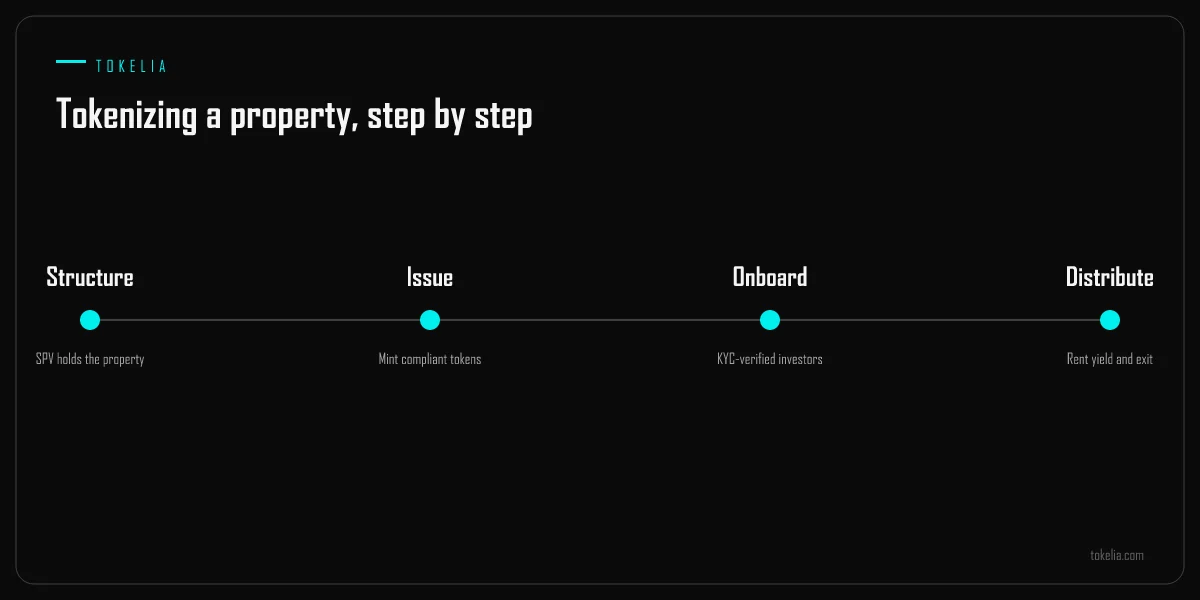
There are six stages between a property and a compliant token that pays rent to verified holders. Each stage builds on the one before it: a weak legal wrapper undermines a well-built token, and a well-designed offering is worthless without investors who can actually complete it.
| Step | What happens | What you need |
|---|---|---|
| 1. Structure and legal wrapper | The property is valued, title is confirmed, and an SPV is formed to hold it | Valuation, title search, corporate formation, securities counsel |
| 2. Design the offering | The economic terms (equity, debt or revenue share) and minimums are set | Offering memorandum, cap table design, pricing model |
| 3. Issue the compliant token | The SPV’s shares or notes are represented as tokens on a permissioned standard | Issuance engine, ERC-3643 smart contracts, on-chain identity |
| 4. Onboard investors and run the primary sale | Investors complete KYC, subscribe, fund, and receive tokens at close | KYC/KYB provider, investor portal, banking rails for subscriptions |
| 5. Distribute yield and handle transfers | Rent is paid to current holders; secondary transfers run through compliance checks | Distribution engine, payout rails, a compliance contract |
| 6. Exit and redemption | The property sells, or holders redeem at maturity, and proceeds flow back to token holders | Wind-down process, final distribution, cap table closure |
The token is never the property. It is a claim against the legal entity that holds the property, so the entity comes first. In practice this means forming a special purpose vehicle (SPV) whose sole purpose is to hold title to the asset, commissioning an independent valuation, confirming title is clean and free of undisclosed liens, and preparing the disclosures investors will rely on to decide whether to buy in.
This is also where most of the legal risk lives. An SPV that is not properly capitalized, a valuation that cannot be defended, or disclosures that omit a material fact do not become safer because the ownership is later represented as a token. Get this stage right before writing a line of smart contract code, because everything downstream inherits its quality.
With the SPV and the asset documented, the next decision is the shape of the offering: will investors hold equity in the SPV, a debt instrument secured against the property, or a right to a share of rental revenue without equity ownership. Each model has a different risk profile, a different payout mechanic, and different investor expectations, and the choice should follow how the deal is actually financed, not a default template.
This stage also sets the minimum investment, the total raise, and the number of tokens that represent full ownership of the SPV. A lower minimum widens the investor base but adds more holders to manage; a higher minimum concentrates the cap table but narrows who can participate. Pricing, minimums and the offering structure typically go through the same securities counsel involved in step one, because they determine which exemption or registration path applies.
Once the offering terms are set, the SPV’s shares or notes are represented as tokens, and this is where the standard matters. ERC-3643 (T-REX) explained covers the mechanics in depth, but the short version is that a plain, permissionless token standard like ERC-20 lets anyone with a compatible wallet receive it, which is unworkable for a security. ERC-3643 ties every token to an on-chain identity through ONCHAINID, and a compliance contract checks eligibility on every transfer, not only at the first purchase.
Issuing the token itself is a relatively fast technical step once the standard and the issuance engine are chosen. The work that takes time is configuring the compliance rules correctly: which jurisdictions are eligible, what holding periods apply, whether there is an investor cap, and how those rules map onto the offering design from step two.
Before anyone can hold a token, they need an on-chain identity backed by verified claims: identity documents, sanctions screening, and, where relevant, accredited or qualified investor status. This is the same KYC discipline that applies across regulated fintech, run through a provider that can issue claims the compliance contract checks automatically.
Once an investor clears verification, they subscribe during the primary sale window, fund their subscription, and receive tokens when the offering closes and funds settle. Funding is where the local rail matters most: an investor in Brazil expects to pay in through PIX, one in Mexico through SPEI, and one in Colombia through Bre-b or a bank transfer, and a platform that only accepts wire transfers loses a meaningful share of the addressable investor base before the first token moves.
Once the property is generating rent, the distribution engine pays it out to whoever holds the token at the relevant date, converting from the property’s operating currency to whatever the investor is owed and routing it through the same kind of local or international rail used for subscriptions. This is the piece tokenization with banking rails covers in detail: a token with no real banking behind it cannot actually pay an investor, no matter how well the smart contract is written.
If the offering permits it, holders can also sell to another eligible, verified investor on a secondary market before the property sells or the project matures. Every secondary transfer runs through the same compliance contract as the primary sale, checking eligibility, holding periods and jurisdiction rules in real time, so a token cannot land in a wallet that has not cleared the required checks.
Every tokenized real estate deal has an end state, whether that is a property sale, a maturity date on a debt instrument, or a buyback provision. When it triggers, the SPV winds down its position, proceeds are calculated per token, and a final distribution closes out each holder’s position. Reporting at this stage matters as much as it did at onboarding: investors need a clear record of what they received and when, and the issuer needs the same record for its own books and for regulators.
Tokenizing a property is not a one-time engineering cost; it carries ongoing operational spend that founders often underestimate on a first deal.
| Cost area | What it covers |
|---|---|
| Legal and structuring | SPV formation, securities counsel, offering documents, jurisdiction-specific advice |
| Valuation and due diligence | Independent appraisal, title search, ongoing property reporting |
| Issuance and compliance infrastructure | Smart contracts, on-chain identity, the compliance layer that enforces transfer rules |
| KYC and investor onboarding | Identity verification, sanctions screening, ongoing re-screening |
| Banking and payout rails | Local and international rails for subscriptions and distributions |
| Ongoing administration | Cap table maintenance, distribution runs, investor reporting |
The practical trade-off most teams face is build versus buy. Standing up an issuance engine, on-chain identity and compliance layer, banking rails and an investor portal from scratch is a multi-quarter effort, most of which is undifferentiated infrastructure rather than anything specific to the property. How to launch a white-label tokenization platform walks through what integrating that stack under your own brand looks like, which is usually the faster path unless tokenization infrastructure itself is the product you are building.
Real estate is often the first asset tokenized in Latin America, and for good reason: it is already well understood by local investors, it already generates documentable rental income, and it does not require an education campaign to explain the underlying asset, only the token wrapper around it.
Local payment rails decide whether an offering actually reaches investors in practice. An investor in Brazil wants to subscribe and receive distributions through PIX, one in Mexico through SPEI, and one in Colombia through Bre-b or a bank transfer; a platform that only supports wire transfers or crypto on-ramps closes the door on most of the regional investor base before the offering opens. Tokenized structures also give issuers access to investors outside their home market, subject to the securities rules in each jurisdiction, which matters for teams looking to raise beyond a single country’s pool of capital.
Tokenizing real estate reduces some frictions but does not remove the risks that come with the underlying asset or the structure around it.
Tokelia is the full-stack infrastructure to launch a fintech or a tokenization platform in Latin America: virtual accounts, unified crypto-and-fiat rails, local payment rails (PIX, SPEI, Bre-b) alongside ACH, Wire, FedNow, SEPA and FPS, card issuing and real-world asset tokenization, behind one API, with a non-custodial architecture and compliance built into the base stack. Money services are provided by Tokelia LLC, registered as a Money Services Business with FinCEN, and regulated banking is delivered by licensed institutions, so you can launch under your own brand while the hard-to-change parts are already solved.
If you are scoping how to tokenize real estate for your own portfolio or fund, the fastest way to see how the stack fits is to talk to us.
Almost every tokenized real estate deal starts with a special purpose vehicle (SPV) that holds title to the property. The SPV, not the token, is the legal owner; the token represents rights against the SPV, such as equity, debt or a revenue share. Getting this structure wrong, or skipping it, is the most common reason tokenized real estate projects run into trouble later. This is general information, not legal advice; work with counsel in the relevant jurisdiction to set up the structure.
In most cases, yes. A token that represents ownership, debt, or a share of rental income from a property typically meets the definition of a security in jurisdictions that regulate this activity, which brings securities law, KYC and AML obligations, and disclosure requirements into play. This is general information, not legal or investment advice; confirm the treatment that applies to your offering and your investors with qualified counsel.
ERC-3643, also known as T-REX, is the standard built for this use case. It ties each token to an on-chain identity through ONCHAINID, checks identity claims such as KYC status, and runs every transfer through a compliance contract that blocks it if the recipient is not an eligible, verified investor. A standard permissionless token, such as plain ERC-20, does not enforce any of that and is generally unsuitable for a security.
After completing KYC and identity verification, an investor subscribes during the primary sale, funds the subscription (often through a local rail such as PIX, SPEI or Bre-b, or a wire transfer), and receives tokens once funds settle and the offering closes. The compliance contract checks eligibility at the moment tokens are issued, not just at account opening.
Only if the offering was designed to allow secondary transfers, and only to another eligible, verified investor. The compliance contract enforces holding periods, jurisdiction restrictions and investor caps automatically on every transfer, so a token cannot move to a wallet that has not cleared the same checks the original buyer did.
Topics
Written by
DanielFull-Stack Developer, Tokenization
Daniel is a full-stack developer at Tokelia, working on the tokenization stack. He writes from the build side about how real-world assets move on-chain (real estate, receivables, agribusiness), the standards that keep it compliant (ERC-3643, KYC) and how a team can launch a tokenization platform without building the infrastructure from scratch.
Tell us your use case and we’ll point you to the right layer: infrastructure, tokenization or Yakopay.
We use essential cookies to run this site and, only with your consent, analytics cookies to measure traffic. You can change your choice anytime. Cookie Policy