PLAYBOOK
How to launch a white-label tokenization platform
A build vs buy playbook to launch a white-label tokenization platform in about ten weeks: issuance, ERC-3643 compliance, custody, and banking rails for LatAm.
 By Daniel 9 min read
PLAYBOOK
A build vs buy playbook to launch a white-label tokenization platform in about ten weeks: issuance, ERC-3643 compliance, custody, and banking rails for LatAm.
By Daniel 9 min read Asset managers, real estate sponsors and fintechs increasingly want to launch a tokenization platform without spending a year building blockchain infrastructure from scratch. A white-label tokenization platform lets an operator put its own brand on token issuance, investor onboarding and secondary transfers, while relying on infrastructure that already handles the technical and compliance heavy lifting underneath. This guide is a practical build vs buy playbook: what the full stack requires, why building everything in-house is usually slow and expensive, and a roughly ten-week plan to go from scoping to a live issuance, with a look at how the go-to-market changes in Latin America.
A tokenization platform is not just a smart contract that mints tokens against an asset. Taking an asset from a spreadsheet to a transferable, compliant, investor-ready instrument requires seven pieces working together:
Each of these pieces can be built. Very few teams should build all seven before a first issuance, because none of them is optional: skip the identity layer and the token cannot enforce eligibility; skip real banking rails and investors have no practical way to fund or exit their position; skip reporting and the operator ends up reconstructing cap tables by hand every quarter. A launch plan needs all seven scoped from day one, even if some are integrated rather than built.
Each component above sits behind its own specialist skill set. A production-grade ERC-3643 token needs contract development and independent security review. A working compliance layer needs an identity registry integration and rule logic that can be reconfigured per market without a redeploy. Banking rails need either money-transmission registration or a banking partnership in every market you touch. Non-custodial custody needs key-management infrastructure that has been tested under real failure conditions, not just a demo.
Taken together, an in-house build usually means assembling smart contract engineers, a compliance function, and banking integration engineers well before the first token is minted, and the calendar stretches accordingly. That is time a real estate sponsor, an asset manager or a fintech founder would rather spend on the asset and the investor relationship than on plumbing that looks the same at every other tokenization platform.
The cost is not only engineering time. Every extra month before launch is a month of legal and compliance retainers, a month of holding an asset off the market, and a month where a competitor with an integrated stack can already be onboarding investors. None of that spend improves the asset or the investor experience; it only reproduces infrastructure that already exists elsewhere.
| Component | Build in-house | Buy or integrate |
|---|---|---|
| Issuance engine (ERC-3643 token) | Contract development, audits, ongoing maintenance | Deploy on an existing, audited issuance engine |
| Identity and compliance | Build ONCHAINID integration and per-market rule logic | Use a configurable identity registry and compliance module |
| Custody | Build or license non-custodial wallet infrastructure and key management | Integrate an existing non-custodial custody provider |
| Banking rails | Negotiate banking partnerships and registrations market by market | Integrate a provider that already holds the rails and registrations |
| Investor portal | Build KYC flows, document handling and reporting UI from scratch | White-label an existing investor portal under your brand |
| Reporting | Build cap table and distribution reporting pipelines | Use reporting built into the issuance and banking stack |
Buying the plumbing does not mean giving up control. The issuer still sets the asset terms, the pricing, the eligibility criteria and the brand the investor sees. What changes is that none of that time goes into re-inventing a tokenization platform that a specialized provider has already built and tested.
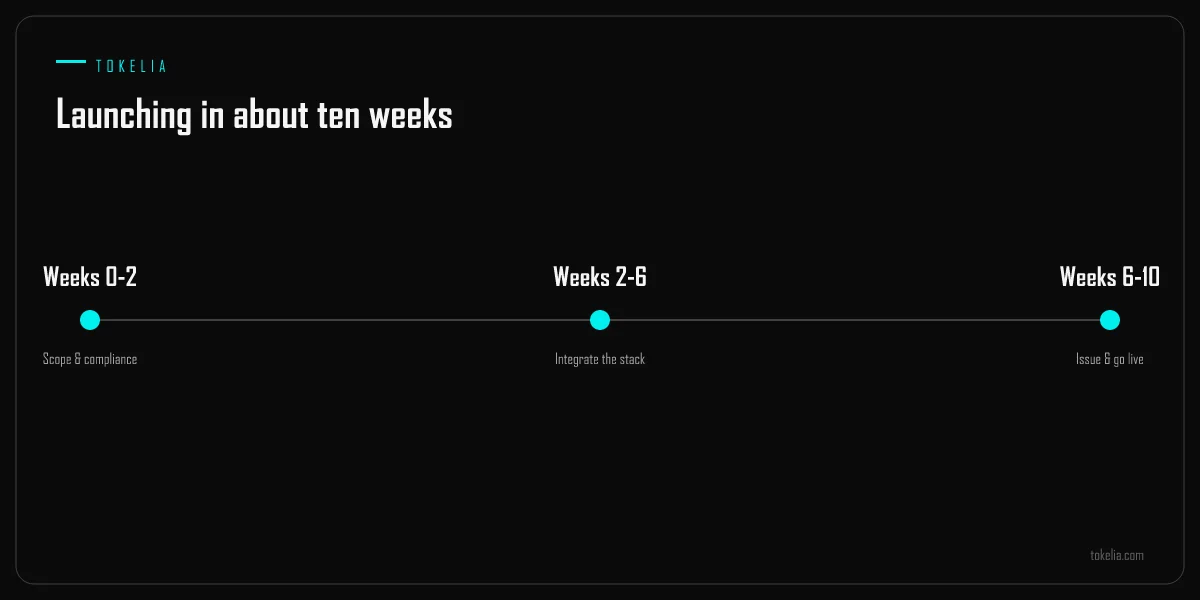
Once the decision is to integrate rather than build, a first issuance on a white-label tokenization platform tends to follow three phases over about ten weeks, matching the timeline above.
| Weeks | Phase | Key work |
|---|---|---|
| 0-2 | Scope and compliance | Define the asset class and target jurisdictions, choose the issuance structure (often an SPV), map investor eligibility and compliance requirements per market, and select the banking rails needed for subscriptions and redemptions |
| 2-6 | Integrate the stack | Deploy the ERC-3643 token and compliance modules, connect the identity registry and KYC provider, wire in banking rails for fiat in and out, configure the investor portal and custody, and set the transfer rules |
| 6-10 | Issue and go live | Onboard the first cohort of investors, run the subscription cycle, mint tokens against confirmed subscriptions, open eligible investors to secondary transfers, and publish the first reporting cycle |
Weeks 0-2 are mostly decisions, not code: which asset, which SPV or issuance vehicle, which markets you can legally sell into, and which rails your subscribers will actually use to fund their position. Getting this scoping wrong is the single biggest cause of delay later, because compliance rules and banking rails are hard to retrofit once investors are already onboarded.
Weeks 2-6 are integration work against the stack chosen in the build vs buy step: the token and compliance contracts go live on-chain, KYC and identity checks are wired into onboarding, and the banking rails that will handle subscriptions and redemptions are connected end to end. This is also when secondary-transfer rules (lock-ups, whitelists, jurisdiction checks) get configured, so they are enforced automatically rather than added after the first transfer request arrives.
Weeks 6-10 is where the tokenization platform goes live: investors complete onboarding and KYC, funds move through the banking rails, tokens are minted against confirmed subscriptions, and the first reporting cycle goes out. A realistic ten-week plan assumes the stack is being integrated, not built; teams building components from scratch should expect that first phase alone to take longer.
This is general product and market information, not legal or investment advice. Token structures, licensing requirements and investor eligibility rules vary by jurisdiction and by asset class, so confirm the specifics of any issuance with qualified counsel before you launch.
Latin America is a strong starting market for a tokenization platform, and the choice of first asset class matters as much as the technology. Two asset types tend to work well as a first issuance: fractional real estate income (rental yield shares that investors can understand at a glance) and short-duration receivables or invoices, where the holding period is short enough to prove out redemptions and cash flows within months rather than years. Our guides on how to tokenize real estate and tokenized invoice factoring walk through both in more detail.
On the payment side, the rails matter as much as the token. Subscriptions and redemptions need to move through the rails investors actually use in each market: PIX in Brazil, SPEI in Mexico, Bre-b and bank transfer in Colombia, with ACH, wire, FedNow or SEPA available for cross-border investors funding in USD or EUR. Pairing tokenization with real banking rails, rather than a single generic collection account, is what turns a token demo into a product investors will actually fund and redeem from. See our note on tokenization with banking rails built in for how the two layers connect.
Liquidity expectations also need to be set honestly with investors from day one. A tokenization platform makes transfers technically possible, but a real secondary market still depends on demand, on the transfer rules configured for the asset, and often on the jurisdiction of the counterparty. Starting with an asset class and investor base where the compliance team already understands the transfer restrictions (a domestic real estate vehicle, for example, before a cross-border one) reduces the number of open questions during the first live cycle.
“White-label” means the operator’s brand, not the infrastructure provider’s, is what investors see throughout onboarding, subscriptions, statements and redemptions. The tokenization platform, the compliance layer and the banking rails sit behind that brand rather than in front of it. This matters for asset managers, real estate sponsors and fintechs that want to offer tokenized products without becoming a blockchain company themselves: the infrastructure is consumed, not built, and the relationship with the investor stays entirely with the operator. For the adjacent question of building a broader fintech product on the same kind of infrastructure, see our guide on how to build a crypto and fiat payment platform.
When evaluating a white-label provider, the practical questions are usually the same ones that shaped the build vs buy table above: does it cover ERC-3643 issuance and identity out of the box, does it hold or partner for the banking rails your target market needs, and does it let you configure transfer rules per asset without waiting on the provider’s own roadmap. A provider that only covers the token, and leaves banking rails and compliance as separate integrations, tends to reintroduce the same delays a full in-house build would have caused.
Tokelia is the full-stack infrastructure to launch a fintech or a tokenization platform in Latin America: virtual accounts, unified crypto-and-fiat rails, local payment rails (PIX, SPEI, Bre-b) alongside ACH, Wire, FedNow, SEPA and FPS, card issuing and real-world asset tokenization, behind one API, with a non-custodial architecture and compliance built into the base stack. Money services are provided by Tokelia LLC, registered as a Money Services Business with FinCEN, and regulated banking is delivered by licensed institutions, so you can launch under your own brand while the hard-to-change parts are already solved.
If you are scoping a tokenization platform launch, talk to our team and walk through the stack against your own asset and target market.
Seven pieces working together: an issuance engine, on-chain identity and compliance under ERC-3643, non-custodial custody, banking rails for subscriptions and redemptions, an investor portal, secondary-transfer rules, and reporting. A launch that skips any of these usually ends up rebuilding it later under pressure.
Most teams should buy the plumbing (smart contracts, identity and compliance modules, banking rails, custody) and keep control over what actually differentiates them: the asset terms, the investor relationship and the brand. Building all seven components in-house is possible, but it usually takes a specialized team well over a year before the first issuance.
With an existing stack to integrate against, a first issuance is realistic in roughly ten weeks: about two weeks to scope the asset and compliance requirements, four weeks to integrate the stack, and four weeks to onboard investors and go live. Building the stack from scratch adds many months before that clock even starts.
ERC-3643 pairs each investor with an on-chain identity (ONCHAINID) and enforces a compliance contract on every transfer, so eligibility, jurisdiction and lock-up rules are checked automatically instead of relying on manual review after the fact. It is the standard most permissioned real-world-asset tokens are built on today.
Real estate income shares and short-duration receivables or invoices tend to work well as first issuances, because the cash flows are easy for investors to understand and the holding period is short enough to prove the model quickly. On the payment side, pairing local rails (PIX in Brazil, SPEI in Mexico, Bre-b in Colombia) with ACH, wire or SEPA for cross-border investors covers most subscription and redemption flows.
Topics
Written by
DanielFull-Stack Developer, Tokenization
Daniel is a full-stack developer at Tokelia, working on the tokenization stack. He writes from the build side about how real-world assets move on-chain (real estate, receivables, agribusiness), the standards that keep it compliant (ERC-3643, KYC) and how a team can launch a tokenization platform without building the infrastructure from scratch.
Tell us your use case and we’ll point you to the right layer: infrastructure, tokenization or Yakopay.
We use essential cookies to run this site and, only with your consent, analytics cookies to measure traffic. You can change your choice anytime. Cookie Policy