PRODUCT
Why tokenization needs banking rails
Tokenization is only half a product without banking rails. See why tokenization banking rails, not tokens alone, is what makes subscriptions and payouts work.
 By Daniel 9 min read
PRODUCT
Tokenization is only half a product without banking rails. See why tokenization banking rails, not tokens alone, is what makes subscriptions and payouts work.
By Daniel 9 min read A tokenized bond or a tokenized invoice is not a finished product until real money can move in and out of it. Investors do not pay in ERC-3643 tokens; they pay in pesos, reais, dollars and euros, over PIX, SPEI, Bre-b, SEPA or ACH. Coupons, rent and invoice payoffs land the same way, in a bank account, not on a blockchain explorer. That is the case for tokenization banking rails: the on-chain token is only half the product, and the fiat plumbing around subscriptions, redemptions and payouts is the other half, the part most tokenization-only platforms leave you to build yourself.
Subscriptions and redemptions are fiat events wrapped around an on-chain one. An investor pays, that payment settles, and only then does a compliance contract mint or transfer a token to their wallet. Redemption runs the same path in reverse: a token is burned or transferred, and the value that was locked in it has to reach the investor’s real bank account, in real currency, on a real rail.
If those settlement steps live outside your platform, in a spreadsheet, a manual wire, or a separate vendor’s dashboard, tokenization stops being a product and becomes a reconciliation problem. The token standard itself, ERC-3643, handles identity and compliance at the transfer level (an ONCHAINID per holder, a compliance contract checked on every move), which is exactly why it does not, and should not, try to move fiat. That is a different layer, and it needs to be built and operated with the same rigor as the token engine, not bolted on afterward.
Every subscription starts as a fiat payment, and every redemption ends as one. The rails differ by currency, and getting them right market by market is most of the operational work behind a tokenization product:
None of these are optional extras. An investor based in São Paulo expects to pay and get redeemed in PIX, not to wire dollars through a correspondent bank because your platform only speaks one rail. Coverage across these rails is what turns a token launch into something an investor in Latin America can actually use, the same way a multi-currency account and unified ledger turns multiple currencies into one reconciled balance instead of five disconnected ones.
Most tokenization vendors are honest about what they sell: a token issuance engine, a cap table, and a compliance contract. What they usually do not sell is the fiat side, which means you end up assembling it from separate parts, each with its own contract, its own support queue, and its own failure mode.
| Layer | Tokenization-only stack | Tokenization + banking rails |
|---|---|---|
| Subscription payment | Manual wire or a bolted-on processor | Native PIX, SPEI, Bre-b, ACH, SEPA collection |
| Investor KYC/AML | Separate vendor, separate integration | Built into the same onboarding flow |
| Token issuance | On-chain only, decoupled from payment status | Triggered once fiat settlement confirms |
| Redemption payout | Manual reconciliation, delayed transfers | Automated payout to the investor’s bank account |
| Recurring cash flows (rent, coupons) | Off-platform collection and distribution | Settled and distributed through the same rails |
| Off-ramp to fiat | A separate on/off-ramp integration | Part of the same API and ledger |
| Compliance monitoring | Split across vendors, hard to audit | One event stream, one audit trail |
| Vendor count | Three to five, each with its own SLA | One stack, one API |
Every row on the left is a place where a project stalls: a redemption that cannot pay out because there is no connected banking rail, a subscription that clears on-chain before the fiat has actually settled, a KYC process that does not talk to the compliance contract. None of these are exotic edge cases. They are the default outcome of treating tokenization as a self-contained product instead of one layer of a payments stack.
Tokenizing an asset does not remove the obligation to move real money against it. A tokenized real estate deal still has to collect rent and distribute it to token holders every month, in the local currency the tenant actually pays in. A tokenized bond still pays coupons on a schedule, in cash, to a bank account. A tokenized invoice is only useful if the payoff from the debtor, once it arrives, actually reaches the investors who funded it, and does so on a rail that clears in days, not weeks.
These recurring cash flows are where a tokenization-only platform quietly becomes a support burden. Someone has to reconcile which token holder is owed what, convert that into a payout instruction, and push it out over a banking rail your token engine was never built to talk to. When the banking layer is native to the platform instead of external to it, that distribution is a scheduled job against the same ledger that tracks the tokens, not a manual export into someone else’s payment system.
The scale problem compounds with the number of holders. A tokenized bond with twelve investors is a manageable spreadsheet. A tokenized real estate deal or a factoring pool with a few hundred token holders, each owed a different amount in a different currency, on a different rail, is not something a team should be reconciling by hand every payout cycle. That is exactly the kind of recurring operational load that banking rails, built into the same stack as the token engine, are meant to absorb automatically.
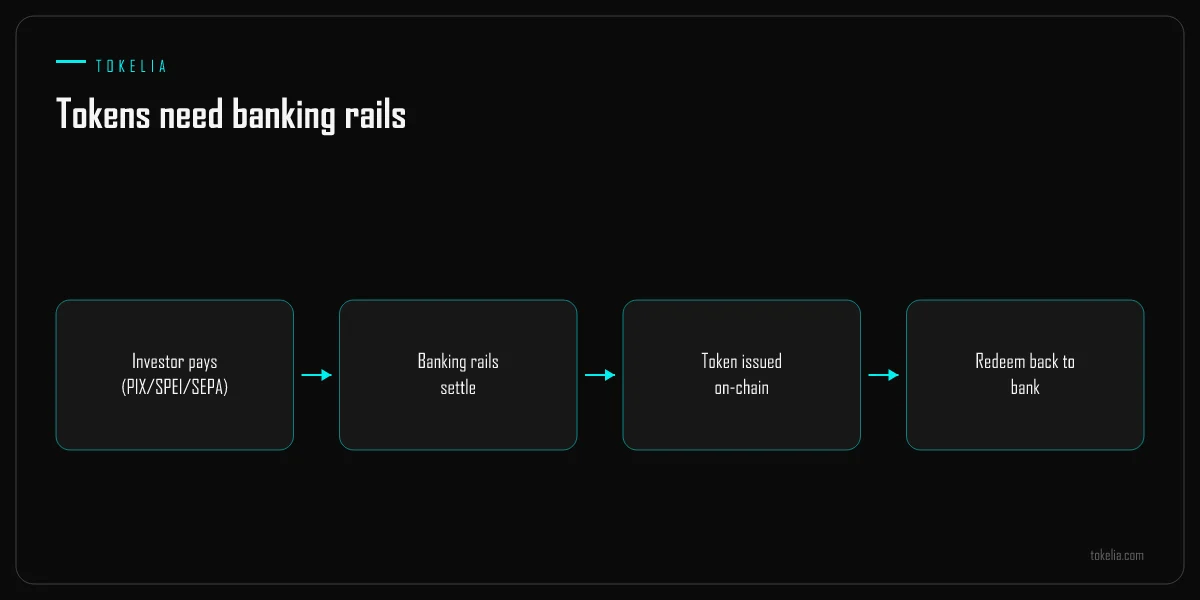
The figure above is the shape of the whole product. An investor in Mexico pays a subscription over SPEI, or an investor in Brazil pays over PIX, or a European investor pays over SEPA. That payment settles through banking rails, the platform confirms the funds are real and compliant, and a token is issued on-chain to the investor’s wallet, checked against their ONCHAINID and the asset’s compliance contract. When it is time to redeem, exit, or receive a coupon, the process reverses: the token is burned or transferred, and the value moves back out through banking rails to the investor’s actual bank account.
Cut any link in that chain and the product breaks. A tokenization engine with no banking rails can issue a token, but it cannot take the investor’s money to begin with, or pay them back at the end. A payments platform with no tokenization cannot represent fractional ownership of the underlying asset at all. Tokenization banking rails, run as one connected stack rather than two vendors passing a file back and forth, is what keeps the loop from breaking at the handoff.
Latin America is where this gap shows up fastest, because the region runs on local rails that most international tokenization vendors were never built to reach. A platform issuing tokens for a São Paulo real estate deal needs PIX, not a workaround through a card network. A Mexico City invoice factoring desk needs SPEI, not a three-day international wire. A Colombian issuer needs Bre-b and domestic bank transfer, not a proxy account in another country.
Building tokenization banking rails for Latin America specifically also means solving on-ramp and off-ramp between crypto and fiat for currencies that most global infrastructure treats as an afterthought. An investor should be able to fund a subscription in reais or pesos and receive a redemption the same way, without converting through a currency their bank does not support. That is infrastructure work, not a token design decision, and it is the work that actually determines whether a tokenization product works in this region or just works on a pitch deck.
Tokelia is the full-stack infrastructure to launch a fintech or a tokenization platform in Latin America: virtual accounts, unified crypto-and-fiat rails, local payment rails (PIX, SPEI, Bre-b) alongside ACH, Wire, FedNow, SEPA and FPS, card issuing and real-world asset tokenization, behind one API, with a non-custodial architecture and compliance built into the base stack. Money services are provided by Tokelia LLC, registered as a Money Services Business with FinCEN, and regulated banking is delivered by licensed institutions, so you can launch under your own brand while the hard-to-change parts are already solved.
If you are scoping a tokenization product and want to see the banking rails behind it, book a demo and we will walk through subscriptions, redemptions and payouts on a real flow.
Because subscriptions and redemptions are fiat events, not on-chain ones. An investor pays in local currency through a rail like PIX, SPEI or SEPA, and only once that payment settles does a compliant token get issued or transferred. Redemption runs the same path in reverse, back to a real bank account. Without banking rails behind it, a tokenization platform can mint tokens, but it cannot actually take a subscription or pay out a redemption.
A tokenization-only stack issues and tracks tokens on-chain but leaves subscription payments, redemptions, recurring cash flows and off-ramp to fiat for you to stitch together with separate banking partners, payment processors and manual reconciliation. Tokenization plus banking rails puts fiat collection, compliance and payout in the same stack as the token engine, so a subscription, an issuance and a redemption are one connected flow instead of three vendors.
Compliant tokenization of real-world assets commonly uses ERC-3643, which pairs each token with an on-chain identity (ONCHAINID) and a compliance contract that checks eligibility on every transfer, not just at issuance. That standard handles who is allowed to hold or move the token. It does not move fiat, which is why banking rails are a separate, necessary layer around it.
For fiat subscriptions and payouts, the real local rails are PIX in Brazil, SPEI in Mexico, and Bre-b or bank transfer in Colombia, alongside ACH, ACH Same Day, Wire and FedNow for USD, SEPA (Standard and Instant) for EUR, and Faster Payments (with BACS above 1 million pounds) for GBP. These are the rails that actually reach local bank accounts, rather than workarounds that add friction and cost.
No. This article is general information about how tokenization and banking infrastructure fit together, not legal or investment advice. Rules for issuing and distributing tokenized assets vary by jurisdiction and by asset type, so confirm your specific structure with qualified legal and tax counsel before you launch.
Topics
Written by
DanielFull-Stack Developer, Tokenization
Daniel is a full-stack developer at Tokelia, working on the tokenization stack. He writes from the build side about how real-world assets move on-chain (real estate, receivables, agribusiness), the standards that keep it compliant (ERC-3643, KYC) and how a team can launch a tokenization platform without building the infrastructure from scratch.
Tell us your use case and we’ll point you to the right layer: infrastructure, tokenization or Yakopay.
We use essential cookies to run this site and, only with your consent, analytics cookies to measure traffic. You can change your choice anytime. Cookie Policy