PLAYBOOK
Tokenized invoice factoring: liquidity from receivables
Tokenized invoice factoring turns unpaid receivables into fractional, investor-funded instruments that settle faster and with more transparency.
 By Daniel 9 min read
PLAYBOOK
Tokenized invoice factoring turns unpaid receivables into fractional, investor-funded instruments that settle faster and with more transparency.
By Daniel 9 min read Small and mid-size businesses routinely wait 30, 60 or 90 days to get paid on invoices they have already delivered against. Tokenized invoice factoring addresses that gap by turning an unpaid receivable into a claim that can be funded by many investors at once, settled faster, and tracked with more transparency than a paper assignment. This guide walks through how the mechanics work, who benefits, what risks still apply, and how the model plays out in Latin America.
None of this changes the underlying economics of factoring: someone still advances cash today against money owed later, at a discount. What changes is the plumbing.
Invoice factoring exists because revenue and cash are not the same thing. A supplier ships goods, issues an invoice, and then waits out the buyer’s payment terms while its own payroll, inventory and rent keep coming due on a much shorter clock. Receivables finance closes that gap: a business sells or pledges its unpaid invoices to get cash now, at a discount, instead of waiting for the debtor to pay.
For SMEs in particular, this working capital gap is often the binding constraint on growth. A company can have a full order book and still run out of cash, because growth means issuing more invoices, and more invoices with the same payment terms means a bigger funding gap before collection. Traditional factoring and receivables finance solve for exactly this, but they typically concentrate funding with one factor, price the discount around that factor’s own cost of capital, and settle through slow, paperwork-heavy bank processes.
Tokenized invoice factoring keeps the core mechanic (advance cash against a receivable, collect at maturity) and changes how the claim is funded, tracked and settled. Four improvements show up consistently:
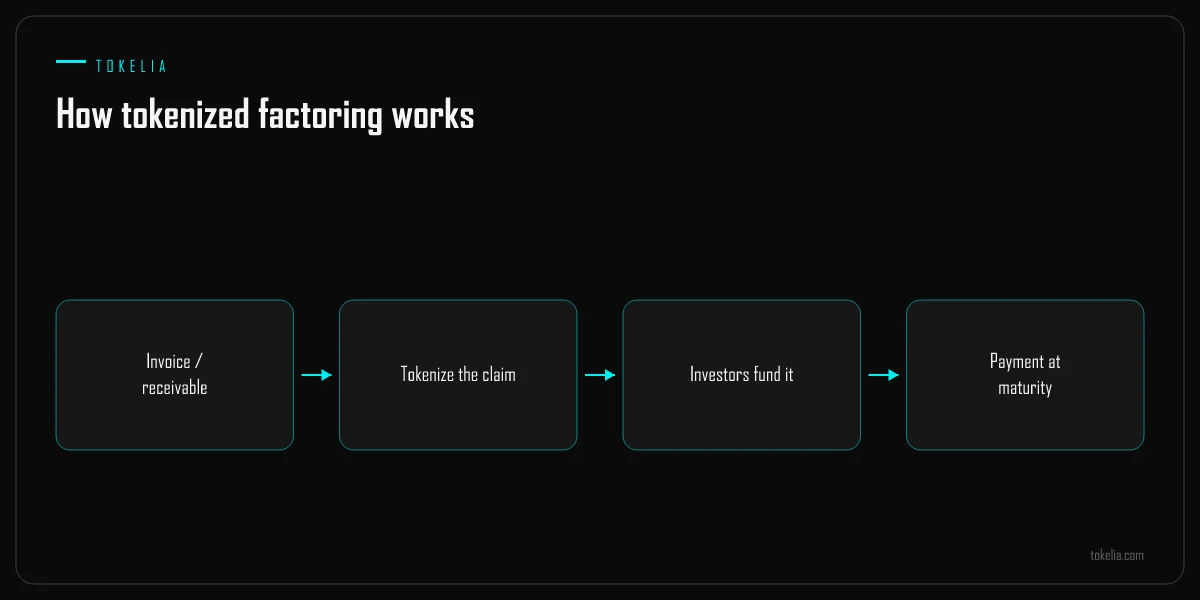
The figure above shows the sequence that makes tokenized invoice factoring work:
Nothing in that sequence changes what a receivable fundamentally is, an obligation the debtor already owes. Tokenization changes who can fund it, and how the funding and payoff are recorded.
The gap between the face value of the receivable and the amount the originating business actually receives is the discount, and it is where the economics of tokenized invoice factoring live. That discount generally prices in three things: the time value of money between funding and maturity, the perceived credit risk of the specific debtor, and a margin for the platform that verifies, structures and services the claim. A receivable from a well-established, investment-grade buyer with a short maturity typically prices at a tighter discount than one from a newer or less established debtor with a longer payment term. Because the claim is tokenized, that pricing can in principle be shown to investors before they fund, rather than negotiated privately between the originator and a single factor.
SMEs seeking liquidity get access to a funding base that is not limited to a single factor’s appetite or balance sheet. Because many investors can each take a small slice of a receivable, an originator is not fully dependent on one counterparty deciding to fund (or not fund) a given invoice. That can matter most in the moments a growing business needs it least to fail: a large order that requires more working capital than usual, or a seasonal spike where one factor’s limits would otherwise cap how much cash the business can pull forward.
Investors seeking short-duration yield get exposure to a well-understood asset class, receivables typically pay off in weeks to a few months, with a defined maturity and a discount that functions as the return. Fractional tokens also let investors diversify across many receivables and debtors instead of concentrating in one large position, and the shorter duration compared to many other fixed-income instruments means capital is not locked up for years to earn a return.
Tokenizing a receivable does not remove the risks that come with factoring; it changes how those risks are recorded and distributed.
A tokenized receivable is typically structured as a regulated financial product or security, not an unregulated collectible. That means the usual securities-law questions apply: who can issue the offering, who is eligible to invest, what disclosures are required, and under what registration or exemption the offering operates. On top of that, participants (both the originating business and investors) generally go through KYC and AML checks, and compliant token standards like ERC-3643 build identity verification (ONCHAINID) and transfer restrictions directly into the token, so only verified, eligible holders can hold or receive it. Rules vary by jurisdiction and continue to evolve, so treat this section as general information, not legal advice, and confirm the specifics with qualified counsel before issuing or investing.
| Dimension | Traditional factoring | Tokenized factoring |
|---|---|---|
| Funding source | Usually one factor’s balance sheet | Fractional funding from many investors |
| Settlement | Manual bank transfers, paperwork | Digital rails, faster once verified |
| Transparency | Separate records per party | Shared, on-chain record of the claim |
| Payoff logic | Manual reconciliation at maturity | Programmable, triggered at maturity |
| Minimum ticket size | Often high, favors larger invoices | Can be lower, via fractional positions |
| Regulatory treatment | Commercial finance, varies by market | Usually a regulated security, plus KYC/AML |
Latin America is a natural market for this model because receivables finance is already a familiar tool there, even if the vocabulary shifts by country. In Brazil, businesses work with duplicatas and recebíveis, trade receivables with a long history of being discounted and financed locally. In Mexico and Colombia, the equivalent instrument is usually called a factura, an invoice that can be factored once confirmed by the buyer.
What tokenization adds in this region is a funding and settlement layer that can plug into local rails: subscriptions (investors funding a receivable) and payoffs (debtors and investors getting paid) can move over PIX in Brazil, SPEI in Mexico, or Bre-b and bank transfer in Colombia, instead of relying only on international wires. That keeps both legs, funding in and payoff out, inside rails businesses and investors already use day to day, while the receivable itself is tracked as a token behind the scenes.
Tokelia is the full-stack infrastructure to launch a fintech or a tokenization platform in Latin America: virtual accounts, unified crypto-and-fiat rails, local payment rails (PIX, SPEI, Bre-b) alongside ACH, Wire, FedNow, SEPA and FPS, card issuing and real-world asset tokenization, behind one API, with a non-custodial architecture and compliance built into the base stack. Money services are provided by Tokelia LLC, registered as a Money Services Business with FinCEN, and regulated banking is delivered by licensed institutions, so you can launch under your own brand while the hard-to-change parts are already solved.
For the broader context behind tokenized receivables:
This article is general information, not legal or investment advice. If you are scoping a tokenized receivables program, the fastest way to pressure-test the fit is to walk a real flow with our team. Book a demo and we will map it to your market and your compliance requirements.
Tokenized invoice factoring represents an unpaid invoice or receivable as a digital claim on a blockchain, then opens that claim to investors who fund it in fractions instead of a single factoring company taking the whole amount. The debtor pays as usual at maturity, and the proceeds flow back to the investors who funded the claim, typically minus a discount and fees.
Traditional factoring usually involves one factor buying the receivable at a discount and carrying the full exposure. Tokenized factoring can split the same receivable into fractional positions funded by many investors, settle the funding and payoff through digital rails, and give investors visibility into the underlying claim. The commercial logic, advancing cash against a receivable, stays the same.
That depends on how the offering is structured and registered in a given jurisdiction. Tokenized receivables are usually structured as a regulated financial instrument or security, so eligibility, disclosures and any accreditation requirements follow the securities and financial regulation that applies where the offering is made. Confirm the exact rules with qualified counsel before participating or issuing.
Debtor default is the central credit risk in any factoring structure, tokenized or not. Programs typically manage it through underwriting before funding, diversification across many receivables and debtors, and sometimes recourse or insurance arrangements. Tokenization does not remove credit risk; it changes how the funding and the claim are recorded and distributed.
Interest is growing across Latin America, where receivables go by different names (duplicatas and recebíveis in Brazil, facturas in Mexico and Colombia) and where local payment rails such as PIX, SPEI and Bre-b can settle funding and payoffs quickly once a program is live. Availability, structure and investor eligibility depend on local regulation, so check the specifics for each market before launching or investing.
Topics
Written by
DanielFull-Stack Developer, Tokenization
Daniel is a full-stack developer at Tokelia, working on the tokenization stack. He writes from the build side about how real-world assets move on-chain (real estate, receivables, agribusiness), the standards that keep it compliant (ERC-3643, KYC) and how a team can launch a tokenization platform without building the infrastructure from scratch.
Tell us your use case and we’ll point you to the right layer: infrastructure, tokenization or Yakopay.
We use essential cookies to run this site and, only with your consent, analytics cookies to measure traffic. You can change your choice anytime. Cookie Policy