GUIDE
Stablecoin Payments for Fintechs, Benefits and Trade-offs
A practical guide to stablecoin payments for fintechs: real benefits, USDT vs USDC vs DAI, network fees, regulation and how to accept and send payments.
 By Lucía 11 min read
GUIDE
A practical guide to stablecoin payments for fintechs: real benefits, USDT vs USDC vs DAI, network fees, regulation and how to accept and send payments.
By Lucía 11 min read Your finance team ships an invoice to a supplier in another country on a Friday afternoon. With traditional rails, that money leaves on Monday, clears midweek, and arrives with fees skimmed at each correspondent bank. With stablecoins, the same payment settles in minutes, on a Saturday, for a network fee measured in cents.
That gap is why stablecoin payments have moved from crypto curiosity to a serious line item in fintech roadmaps. But “add stablecoins” is not a single decision. It is a set of trade-offs about coins, chains, custody and regulation that are cheap to get right early and expensive to retrofit later.
This guide lays out the concrete benefits of adding stablecoin payments to your fintech, the things you need to weigh before you do, and how the integration actually looks. If you are building the wider platform around this, start with our guide on how to build a crypto and fiat payment platform.
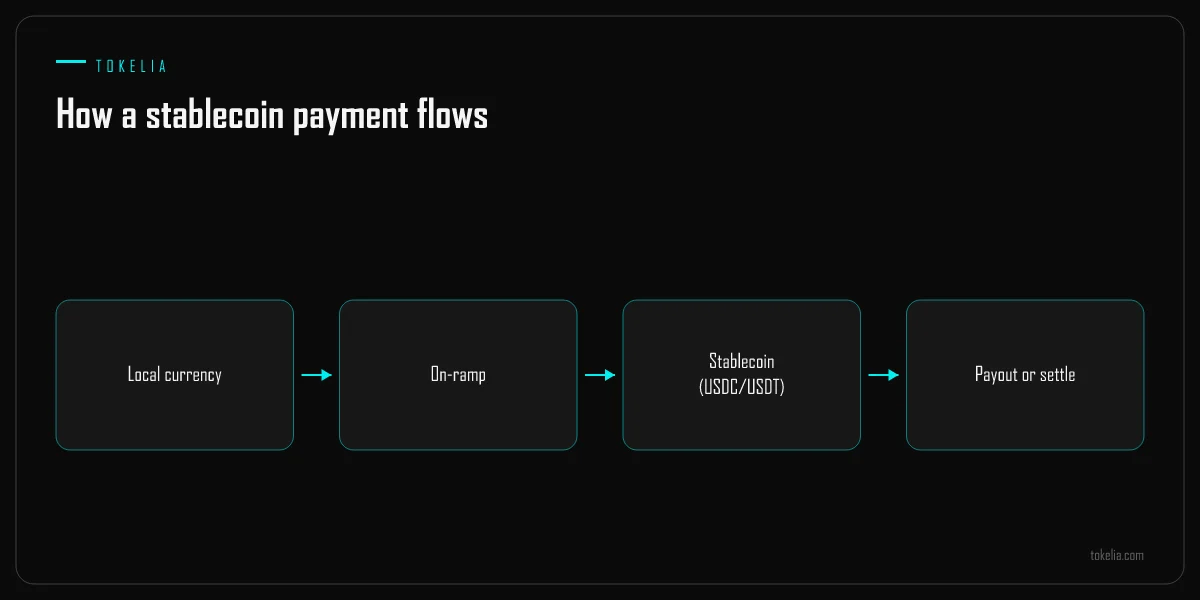
Stablecoin payments move value using blockchain tokens whose price is pegged to a reference asset, almost always the US dollar. Unlike volatile crypto, a stablecoin is designed to hold a steady value, so it behaves like digital dollars that settle on a public network in minutes, 24/7.
There are three broad types, and the differences matter for risk:
| Type | How the peg holds | Examples | Trade-off |
|---|---|---|---|
| Fiat-collateralized | Backed 1:1 by cash and short-term government debt | USDT, USDC | Depends on the issuer and reserve quality |
| Crypto-collateralized | Over-collateralized by other crypto assets in smart contracts | DAI | Transparent on-chain, exposed to crypto volatility |
| Algorithmic | Supply adjusted by code to defend the peg, no full backing | (various, largely out of favor) | Highest depeg risk, several have failed |
For payments, fiat-collateralized coins dominate. The three you will meet most often are USDT, USDC and DAI:
| Coin | Backing | Strength for payments |
|---|---|---|
| USDT | Fiat reserves | Deepest liquidity and reach across emerging markets |
| USDC | Fiat reserves, regular attestations | Preferred where reserve transparency matters |
| DAI | Crypto over-collateralization | Decentralized, no single issuer to redeem from |
The case for stablecoin payments is not ideological. It is operational. Here are the six benefits that show up on a real balance sheet.
Traditional cross-border transfers clear in one to five business days and stop for weekends and holidays. Stablecoin transfers confirm on-chain in seconds to minutes, every day of the year. For a business paying suppliers or contractors, that turns a cash-flow bottleneck into a non-issue.
Legacy correspondent banking stacks fees at each intermediary and hides them in the exchange rate. A stablecoin transfer costs a network fee that is often a fraction of a dollar, plus a transparent conversion fee when you off-ramp to local currency. On high-value corridors, the saving compounds fast.
In much of Latin America, holding and moving dollars through the banking system is slow, capped, or simply hard. Dollar-pegged stablecoins give businesses and their customers dollar-denominated value without needing a US bank account, which is often the real reason a corridor adopts them.
Because stablecoin transfers happen through code, you can automate what used to be manual: scheduled payouts, conditional releases, and reconciliation that matches on-chain events to your ledger automatically. Paired with webhooks and idempotency, this removes a whole category of operational toil.
The strongest setups do not treat stablecoins as a separate island. They unify crypto and fiat balances so a payment can arrive as a stablecoin and settle as local currency in the same flow. If this is new to you, our explainer on multi-currency accounts and a unified crypto-fiat ledger covers the model.
The clearest wins are business-to-business:
These are not speculative. They are the flows most fintechs and marketplaces already run, made faster and cheaper.
Stablecoins are powerful, not free of trade-offs. Weigh these five before you commit.
Stablecoin and virtual-asset rules differ sharply by country and are evolving quickly. In Mexico, for example, the Ley Fintech and central-bank rules govern how regulated institutions may handle virtual assets, and the details of who can offer what continue to change. Treat any general statement as a starting point, not legal advice, and confirm your exact obligations with local counsel. For the licensing picture across markets, see our guide on the licenses to move crypto and fiat.
A stablecoin is only as stable as its backing. A poorly reserved coin can lose its peg (a “depeg”), and an algorithmic coin can lose it catastrophically. Stick to well-reserved, audited coins, and understand who you are trusting: the issuer for redemption, and whoever holds the keys for custody. A non-custodial model, where users control their own funds, changes that risk profile materially. Our comparison of custodial vs non-custodial custody walks through it.
The same stablecoin can cost very different amounts to move depending on the chain it runs on. This is one of the most impactful design choices you will make.
| Network | Typical fee | Speed | Notes |
|---|---|---|---|
| Ethereum | Higher, varies with congestion | Minutes | Deepest liquidity, most integrations |
| Tron | Very low | Seconds to minutes | Heavily used for USDT payments |
| Solana | Fractions of a cent | Seconds | High throughput, low latency |
| Polygon | Very low | Seconds to minutes | Ethereum-compatible, cheap |
There is no single “best” chain. Match the network to your corridor, your counterparties’ preferences, and the fee you can absorb.
Most recipients still pay rent in local currency, so at some point stablecoins meet the banking system. That handoff is the on-ramp and off-ramp, and it is where a lot of real-world friction lives. Reliable settlement to pesos, reais or dollars depends on the quality of that rail. Our piece on the crypto on-ramp and off-ramp explains how it connects.
Faster money still has to be clean money. Stablecoin flows carry KYC/AML, sanctions screening and, above thresholds, travel-rule obligations, the same as fiat. The cleanest architectures embed these checks in the payment flow rather than bolting them on afterward.
In practice, a business accepts stablecoins through wallet infrastructure or a payment gateway that generates a receiving address or checkout, detects the incoming transfer on-chain, and optionally converts it to local fiat. Sending works the same way in reverse.
The cleanest integration is a single REST API with webhooks, so your systems are notified the moment a payment confirms, and idempotency keys, so a retried request never double-pays. A payout request looks roughly like this:
curl -X POST https://api.example.com/v1/payments \
  -H "Authorization: Bearer $API_KEY" \
  -H "Idempotency-Key: 8f1c2a90-3b7d-4e21-9f6a-2c5d1e0b7a44" \
  -H "Content-Type: application/json" \
  -d '{
    "amount": "2500.00",
    "currency": "USDC",
    "network": "polygon",
    "destination": {
      "type": "wallet_address",
      "address": "0xA0b8...F1e2"
    },
    "settlement": { "convert_to": "MXN" },
    "reference": "invoice-2026-0412"
  }'
The response returns a payment id and a pending status; a webhook then fires when the transfer confirms on-chain and again when it settles to fiat. For the whole picture of how these pieces fit around KYC and monitoring, see how KYC and AML work for crypto and fiat payments.
Tokelia is the infrastructure for programmable money: virtual accounts, unified crypto-and-fiat rails, cross-border payments and stablecoins behind one API, on a non-custodial architecture with compliance built into the base stack. Deposits can auto-convert to stablecoin, cross-border transfers settle in stablecoin with FX built in, and payouts reach local rails or wallets in 15+ currencies, so stablecoin payments become a single API call rather than a stitched-together project. Money services are provided by Tokelia LLC, registered as a Money Services Business with FinCEN, with regulated banking delivered by licensed institutions.
If you are weighing stablecoin payments for a specific corridor or use case, the fastest way to pressure-test it is to walk a real flow with our team. Talk to us and we will map it against your requirements.
Stablecoin payments move value using blockchain tokens whose price is pegged to a reference asset, most often the US dollar. Instead of a bank wire or card rail, the payment settles on a public blockchain in minutes, at any hour, and the recipient can hold the stablecoin or convert it to local fiat. For a business, it is a way to send and receive dollars without waiting on correspondent banking.
A stablecoin holds its peg through a backing mechanism, usually reserves of cash and short-term government debt held one-to-one against the tokens in circulation, audited by third parties. When you pay, the token moves from your wallet to the recipient's wallet on a blockchain, and the network confirms the transfer. The issuer stands behind redemption, so one token is designed to always be worth roughly one dollar.
In Mexico, holding and transferring virtual assets is not prohibited, and the Ley Fintech (2018) plus Banco de México rules govern how regulated institutions may handle them. The specifics of who can offer stablecoin services, and how, vary and continue to evolve, so any business operating there should confirm its exact obligations with local regulatory counsel before launching.
Both are dollar-pegged and widely accepted, so the better choice depends on your corridor and counterparties. USDT tends to have deeper liquidity and reach in many emerging markets, while USDC is often preferred where transparency of reserves and regulatory posture matter most. Many payment platforms support both and let the flow decide.
The main advantages are speed (settlement in minutes rather than days), lower cost on cross-border transfers, availability 24/7 including weekends, and programmability that lets you automate payouts and reconciliation. For dollar-scarce markets, they also give reliable access to dollar-denominated value without a US bank account.
A business accepts stablecoins through a payment gateway or wallet infrastructure that generates a receiving address or checkout, detects the incoming transfer, and optionally converts it to local fiat for settlement. The cleanest setups expose this through a single API with webhooks, so your systems are notified the moment a payment confirms.
Stablecoin payments carry a network fee (gas) that depends on the blockchain used, from fractions of a cent on high-throughput networks to a few dollars on congested ones. On top of that, a provider may charge a conversion or off-ramp fee when you settle to local fiat. There is no fixed percentage the way cards charge, so total cost depends on the chain and the on/off-ramp.
Gains from virtual assets can be taxable in Mexico, and businesses must account for stablecoin transactions like any other. Tax treatment depends on how the asset is used (payment, investment, or conversion) and on your specific situation, so treat this as general information and confirm your obligations with a qualified tax advisor.
Topics
Written by
LucíaCompliance & Regulatory
Lucía covers compliance and regulation at Tokelia. She writes about the licensing, KYC/AML and travel-rule questions that come up when a fintech starts moving crypto and fiat, and turns them into decisions a founding team can act on.
Tell us your use case and we’ll point you to the right layer: infrastructure, tokenization or Yakopay.
We use essential cookies to run this site and, only with your consent, analytics cookies to measure traffic. You can change your choice anytime. Cookie Policy