PLAYBOOK
Crypto and Fiat Licenses: MSB, MTL, EMI and MiCA
A practical guide to the licenses that let you move crypto and fiat, from a US money transmitter license and MSB registration to EMI and MiCA in Europe.
 By Lucía 11 min read
PLAYBOOK
A practical guide to the licenses that let you move crypto and fiat, from a US money transmitter license and MSB registration to EMI and MiCA in Europe.
By Lucía 11 min read Every founder building a crypto and fiat product hits the same wall in the first quarter: the licensing question. Can we legally move money? Do we need a money transmitter license? In how many places? The answers feel like a maze because the map spans regulators, countries, and activity types that rarely line up neatly.
This guide is the map. It explains the four licenses that matter most for moving crypto and fiat (a US money transmitter license, MSB registration, a European EMI, and MiCA), what each one actually authorizes, roughly what they cost and how long they take, and the faster path of leaning on a licensed partner. Nothing here is legal advice, and thresholds vary by market, so treat it as orientation and confirm the specifics with fintech counsel.
For the broader build, this pairs with our pillar guide on how to build a crypto and fiat payment platform, where licensing is one of five foundations.
A money transmitter license is a US state-level authorization to receive funds from one party and deliver them to another on that party’s behalf. You generally need one the moment you take custody of, convert, or transmit customer money inside a state that regulates the activity.
That last part is the trap. Licensing usually follows where your customers are, not where you are incorporated. Serve users in a state that requires an MTL, and you are on the hook there, regardless of your Delaware or offshore setup.
The practical test is control of funds. Ask three questions:
Answer yes to any of these and you are likely inside money transmission somewhere. Answer no across the board (because users control their own funds in a non-custodial design and approve each movement) and the perimeter narrows significantly. This is why the custody decision drives the licensing conversation. If you have not settled it, read custodial vs non-custodial before you file anything.
MSB registration and a money transmitter license are often confused, but they operate at different levels and neither replaces the other.
MSB (Money Services Business) registration is a federal filing with FinCEN. It is a one-time registration that anchors your anti-money-laundering obligations under the Bank Secrecy Act across the whole country. It does not, by itself, grant you the right to transmit money.
A money transmitter license is granted state by state. It is the actual permission to move funds, and it comes bundled with bonds, net-worth minimums, and examinations in each state that requires it. A nationwide US operation historically needs a license in nearly every state that has the regime.
| MSB registration (federal) | Money transmitter license (state) | |
|---|---|---|
| Issued by | FinCEN (US Treasury) | Each state’s financial regulator |
| What it authorizes | AML/BSA registration | The right to transmit money in that state |
| Scope | Nationwide | One state per license |
| Grants the right to transmit? | No | Yes |
| Typical timeline | Days to weeks | Months per state |
| Ongoing burden | AML program, reporting | Bonds, net worth, exams, renewals |
The takeaway: you can be a registered MSB and still not be allowed to transmit money in a given state without its license. Both layers matter.
Moving crypto and fiat across borders touches several regimes at once. Here are the four you will meet most often, and what each authorizes.
US money transmitter license (state). The right to receive and send money within a state. This is the workhorse for US fiat movement and, in many states, for crypto activity too.
MSB registration (US federal). Your FinCEN anchor for AML obligations. Required alongside state licensing, not instead of it.
EMI (Electronic Money Institution, Europe). An authorization to issue electronic money and hold client funds, typically obtained in one European jurisdiction and passported across the bloc. It is the closest European analog to holding balances and issuing accounts.
MiCA (Markets in Crypto-Assets, EU). The EU framework that authorizes crypto-asset service providers and sets rules for stablecoin issuance. If you touch crypto in Europe, MiCA increasingly defines the perimeter.
| Regime | Geography | Covers | Custody of client funds | Typical route |
|---|---|---|---|---|
| MSB | United States (federal) | AML registration | N/A | Direct filing |
| Money transmitter license | United States (per state) | Fiat and often crypto transmission | Yes | Direct or via partner |
| EMI | Europe (passportable) | E-money issuance, accounts | Yes | Direct or via partner |
| MiCA | European Union | Crypto-asset services, stablecoins | Depends on activity | Direct or via partner |
A single global crypto-fiat product often needs coverage across all four. That does not mean you must hold all four yourself, which is the whole point of the next two sections.
Getting fully licensed yourself is expensive and slow, which is precisely why most teams do not do it on day one. Exact figures vary by state and jurisdiction and change over time, so treat the ranges below as orientation to confirm, not quotes.
For a full US footprint, direct licensing commonly runs into the hundreds of thousands to low millions of dollars once you stack application fees, surety bonds, minimum net-worth requirements, legal work, and annual renewals. Surety bond sizes and net-worth minimums differ per state, and they compound as you add states.
On timing, licensing a nationwide US footprint yourself typically takes 12 to 24 months or more, because each state runs its own review. European EMI and MiCA authorizations are their own multi-month processes with their own capital requirements.
| Path | Time to go live | Upfront cost profile | Control | Best when |
|---|---|---|---|---|
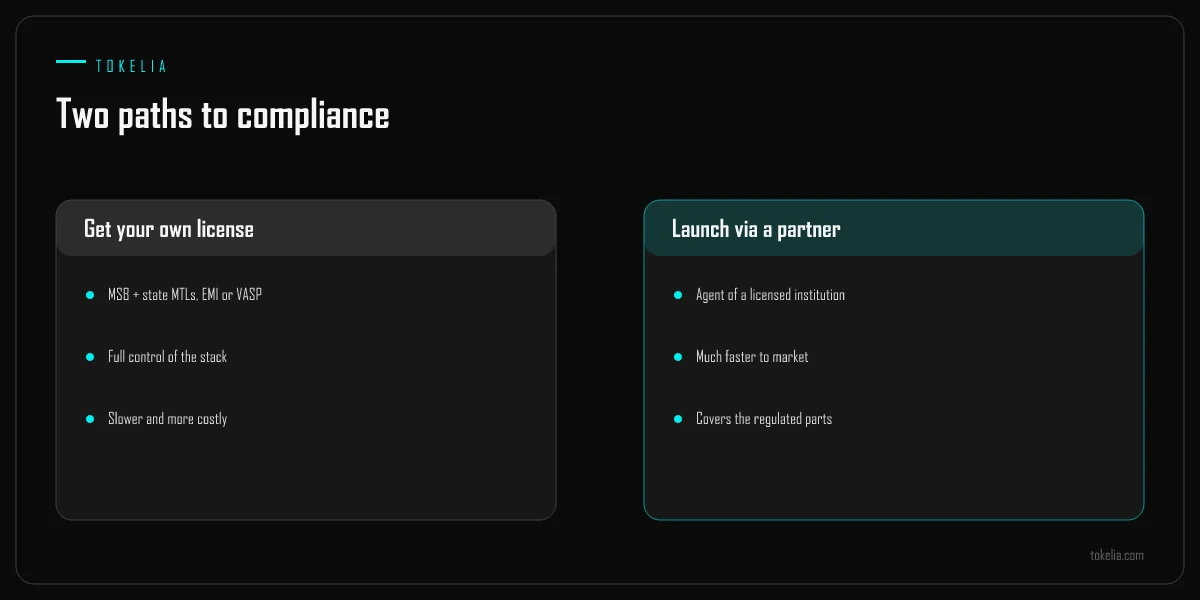
| Get licensed yourself | 12 to 24+ months | High (bonds, net worth, legal) | Full | Licensing is your core moat |
| Operate under a partner | Weeks to a few months | Low to moderate (platform or revenue share) | Shared | You want to launch the product fast |
| Hybrid (partner now, license later) | Weeks, then grow | Staged | Grows over time | You plan to internalize as you scale |
The numbers are why the agent model exists. For most products, the license is not the differentiator, so paying two years and seven figures to build it yourself is the wrong first move.
You do not always need to hold the licenses yourself. Operating as an agent of a licensed institution (often called MTL-as-a-service, a BIN sponsor arrangement for cards, or simply the agent model) lets you launch the product while a partner supplies the regulated permission underneath.
Here is the mechanism. The licensed partner holds the MTL, EMI, or crypto authorization. You build the user experience and the vertical logic. The regulated activity (transmitting funds, issuing e-money, issuing cards) legally happens under the partner’s license, with you acting as its agent. This is the same principle behind Banking-as-a-Service, applied specifically to the licensing layer.
The benefits are speed and cost: weeks instead of years, and no seven-figure bond-and-capital outlay before your first customer. The trade-offs are real too: you share control, you carry a revenue share or platform fee, and you inherit the partner’s market coverage. You also still run your own AML/KYC program and cooperate with the partner’s oversight.
A common pattern is hybrid. Launch on a partner’s licenses to prove the market, then internalize specific licenses later if and where scale justifies the cost. That sequencing keeps your compliance perimeter honest while your engineers ship the product, the same principle behind our 90-day plan to launch your fintech.
A live license, whether yours or your partner’s, is not a one-time hurdle. It is a permanent operating discipline. Whoever holds it must run a continuous compliance program, and even as an agent you carry a meaningful share.
The recurring obligations include:
Two of these deserve extra attention for crypto-fiat products. First, your KYC and AML program is the backbone that examiners will test hardest. Second, cross-border and crypto transfers pull in the travel rule, which requires originator and beneficiary data to travel with qualifying transfers between regulated institutions. Both are far cheaper to build into the flow from the start than to retrofit under an exam deadline.
Licensing is not only a legal artifact; it shows up in how a compliant platform behaves. A well-designed API surfaces the compliance perimeter directly, so your engineers can see it, not just your lawyers. A transfer request against regulated rails, for example, typically carries the KYC status of both parties, screening results, and travel-rule fields, and it fails cleanly when the perimeter is not satisfied.
Here is an illustrative response to a cross-border transfer request, showing how compliance state rides alongside the money movement:
{
  "id": "txn_9f8c2a41",
  "status": "pending_compliance",
  "amount": { "value": "2500.00", "currency": "USD" },
  "rail": "cross_border_stablecoin",
  "compliance": {
    "sender_kyc": "verified",
    "recipient_kyc": "verified",
    "sanctions_screen": "clear",
    "travel_rule": {
      "required": true,
      "originator_attached": true,
      "beneficiary_attached": true
    }
  },
  "hold_reason": "awaiting_beneficiary_institution_ack",
  "idempotency_key": "req_2026_06_16_abc123"
}
Notice what the shape tells you. The transfer is held, not silently dropped, because a compliance step is still open. The travel-rule data is explicit. The idempotency key means a retried request will not double-send. These are the fingerprints of infrastructure built with the license in mind, rather than compliance stapled on afterward.
Before you talk to any provider or regulator, draw your own perimeter. It comes down to three questions, and the answers determine everything else.
With those answers you can decide, per market and per activity, whether to license directly, ride a partner, or defer that market entirely. Get this map from counsel before you scale, not after, because retrofitting a license perimeter is the most expensive kind of rework there is.
Tokelia is the infrastructure for programmable money: virtual accounts, unified crypto-and-fiat rails, card issuing, cross-border payments, and stablecoins, behind one API, with a non-custodial architecture and compliance built into the base stack. Money services are provided by Tokelia LLC, a Delaware company registered as a Money Services Business with FinCEN, with regulated banking delivered by licensed institutions. That combination lets you launch under your own brand while the licensed, hard-to-change parts sit underneath, so your team can focus on the product instead of a two-year licensing project.
If you are mapping your own licensing perimeter, the fastest way to pressure-test it is to walk a real flow with our team. Talk to us and we will help you see which regulated parts can ride on partner licenses and which, if any, you need to hold yourself.
A money transmitter license (MTL) is a US state-level permission to receive money and send it to a third party on someone's behalf. A fintech generally needs one when it takes custody of, converts, or transmits customer funds within a state. If you never hold customer money and operate as an agent of a licensed institution, you can often avoid needing your own MTL, but the line is fact-specific, so confirm it with counsel.
Both, and they are different things. Federal MSB registration with FinCEN is a one-time filing that covers your anti-money-laundering obligations nationwide, but it does not grant the right to transmit money. That right comes state by state, so a nationwide US operation historically needs a license in nearly every state that requires one. Many teams launch faster by riding a licensed partner's licenses instead.
Costs vary widely by state and change over time, so treat any figure as an estimate to confirm. In broad terms, full nationwide licensing runs into the hundreds of thousands to low millions of dollars once you add application fees, surety bonds, minimum net-worth requirements, legal work, and ongoing renewals. Surety bond and net-worth minimums differ per state, which is a large part of why partnering is common.
Licensing a full US footprint yourself typically takes 12 to 24 months or more, since each state reviews on its own timeline. Operating as an agent of a licensed provider (an MTL-as-a-service or agent model) can compress your go-live to weeks, because you build the product while the partner supplies the regulated permission. The trade-off is less direct control and a revenue-share or platform fee.
An active MTL brings continuous duties: a written AML/KYC program, Bank Secrecy Act reporting, filing suspicious activity reports (SARs) and currency transaction reports (CTRs), independent AML audits, maintaining surety bonds and net worth, and periodic state examinations. These obligations exist whether you hold the license or operate under a partner's, though a partner absorbs much of the operational load.
MSB is a US federal AML registration; MTL is a US state license to transmit money; EMI is a European authorization to issue e-money and hold client funds; MiCA is the EU framework that authorizes crypto-asset service providers and stablecoin issuers. They cover different activities and geographies, so a global crypto-fiat product often touches several at once, usually through licensed partners rather than holding all of them directly.
Often, yes. When users keep control of their own funds and approve every movement, you are not holding or transmitting customer money in the classic sense, which can move you outside the heaviest money-transmission requirements. It does not eliminate anti-money-laundering duties, and the analysis is jurisdiction-specific, so treat non-custodial as a way to narrow the perimeter, not erase it.
Topics
Written by
LucíaCompliance & Regulatory
Lucía covers compliance and regulation at Tokelia. She writes about the licensing, KYC/AML and travel-rule questions that come up when a fintech starts moving crypto and fiat, and turns them into decisions a founding team can act on.
Tell us your use case and we’ll point you to the right layer: infrastructure, tokenization or Yakopay.
We use essential cookies to run this site and, only with your consent, analytics cookies to measure traffic. You can change your choice anytime. Cookie Policy