EXPLAINER
The Crypto Travel Rule Explained (for Fintechs)
What the crypto travel rule is, where it comes from, data VASPs must transmit, thresholds by jurisdiction and how to stay compliant without slowing transfers.
 By Lucía 10 min read
EXPLAINER
What the crypto travel rule is, where it comes from, data VASPs must transmit, thresholds by jurisdiction and how to stay compliant without slowing transfers.
By Lucía 10 min read A single crypto transfer can cross three borders and two regulatory regimes before it settles. The travel rule is the reason a name and an account reference are expected to travel with that value the whole way. For any fintech touching regulated crypto or fiat rails, it is one of the compliance requirements most likely to shape how you design transfers.
This explainer covers what the travel rule is, where it comes from, exactly what data has to move, the thresholds that trigger it, how it differs by country, and the operational realities (the sunrise problem, protocols and record keeping) that decide whether your implementation actually works.
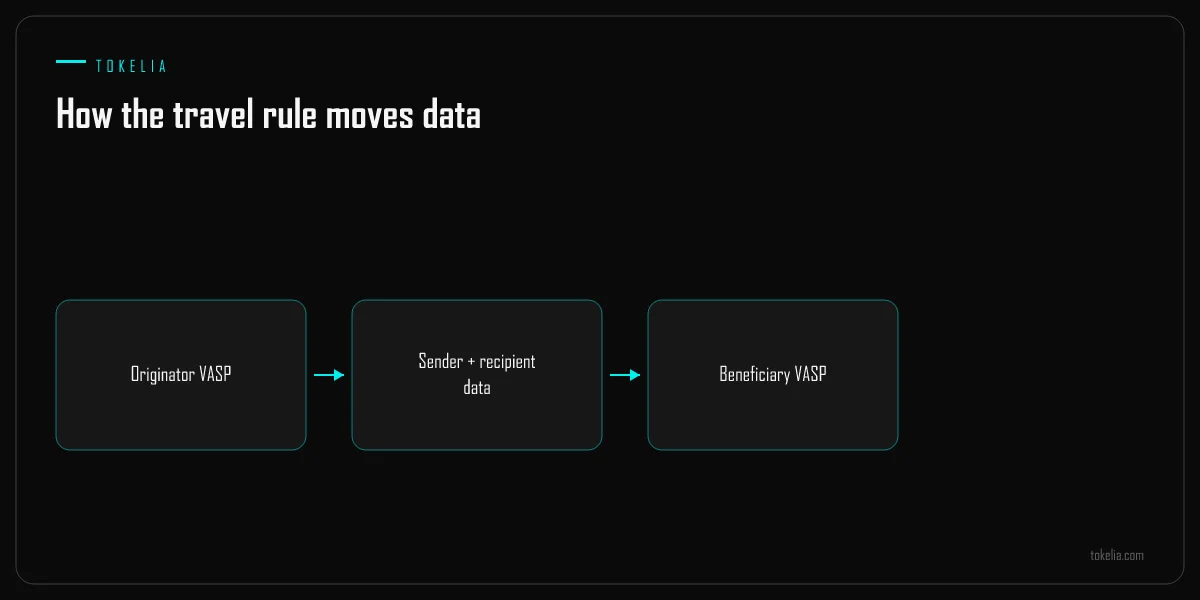
The travel rule requires that identifying information about the sender and the recipient travels alongside a qualifying financial transfer between regulated institutions. In plain terms, the money never moves anonymously above a set amount; the people on both ends travel with it as data.
In crypto, the rule applies to Virtual Asset Service Providers (VASPs): exchanges, custodial wallets, and other businesses that move virtual assets on behalf of customers. When one VASP sends assets to another on a customer’s instruction, both are expected to obtain, hold and securely exchange information about the originator and the beneficiary. This is a core piece of how KYC and AML work for crypto and fiat payments, and it sits on top of, not instead of, identity verification.
The travel rule is not a crypto invention. It is a decades old anti money laundering principle for wire transfers, extended to virtual assets by the global standard setter.
The international standard is FATF Recommendation 16. FATF (the Financial Action Task Force) is the intergovernmental body that sets anti money laundering and counter terrorist financing (AML/CFT) standards adopted by most major economies. Recommendation 16 originally governed wire transfers in traditional finance. In 2019 FATF clarified that the same requirement applies to virtual assets and VASPs, which is why the “crypto travel rule” exists at all.
FATF does not write binding law directly. It sets the standard, and member jurisdictions implement it through their own legislation and supervisors. That two layer structure (one global standard, many national rules) explains most of the complexity you will meet in practice.
At its core the rule is simple: on a qualifying transfer, the originating institution must collect and send a defined set of data, and the beneficiary institution must receive, hold and, where relevant, screen it. The obligation runs in both directions.
Here is the data that typically has to move with a transfer. Exact fields vary by regime, so treat this as the common baseline rather than a legal checklist.
| Party | Data usually required | Purpose |
|---|---|---|
| Originator (sender) | Name; account or wallet reference; physical address, national ID, or date and place of birth | Identify who initiated the transfer |
| Beneficiary (recipient) | Name; account or wallet reference | Identify who received the value |
| Transfer | Amount, asset, timestamp and reference | Tie the parties to a specific movement |
To be compliant, a VASP generally has to do four things with this data: obtain it accurately at the point of transfer, hold it securely, transmit it to the counterparty institution immediately and securely, and retain it for a defined period (commonly at least five years). Missing any one of these breaks the chain the rule is designed to create.
The point of all this is a single outcome: an auditable trail. If every qualifying hop carries originator and beneficiary data, illicit funds cannot move through the regulated system undetected, and supervisors can reconstruct the path of a transfer after the fact.
The travel rule does not apply to every transfer; it kicks in above a de minimis threshold, and that threshold varies by jurisdiction. This is one of the most common founder questions, and the honest answer is that there is no single global number.
FATF recommends a threshold of USD or EUR 1,000, above which the full originator and beneficiary data set must travel. Below it, a lighter set of data may be acceptable. But some jurisdictions set lower thresholds, and some require certain information on every transfer regardless of amount. Cross border corridors can also stack requirements from both the sending and receiving side.
| Scenario | What typically applies |
|---|---|
| Transfer above the local threshold | Full originator and beneficiary data set must travel |
| Transfer below the threshold | Reduced data may be acceptable, but screening obligations still apply |
| Transfer to an unhosted or self custody wallet | Extra due diligence, and in some regimes additional data collection |
| Cross border transfer | Requirements from both jurisdictions may apply |
Because the exact number and the required fields differ market by market, confirm the threshold for each corridor you serve with qualified counsel. Building a fixed threshold into your logic without a way to configure it per market is a common and expensive mistake.
The crypto travel rule is the same principle applied to a different rail. Traditional electronic funds transfers (EFTs), including wires, have carried originator and beneficiary information for decades; crypto simply extends that expectation to VASPs and virtual assets.
The mechanics differ in ways that matter for engineering. In traditional banking, the messaging network that carries the payment instruction also carries the required data in the same message. In crypto, the blockchain settles the value but does not natively carry compliant identity data, so VASPs need a separate channel to exchange it. That gap is why crypto travel rule protocols exist at all, a point we return to below.
A frequent question is whether this touches ACH. The underlying funds travel rule concept applies to wire transfers and predates crypto; ACH batch payments sit under a related but distinct set of network and regulatory requirements. The crypto travel rule specifically governs virtual asset transfers between VASPs. If you are designing on-ramp and off-ramp flows that connect crypto and fiat, you will meet both worlds and should treat their requirements separately.
Every major market builds the FATF standard into its own law, which means the details (thresholds, definitions, effective dates) differ even though the principle is shared. Below is a high level orientation, not legal advice; confirm current specifics with counsel in each market.
| Jurisdiction | Framework (in general terms) |
|---|---|
| United States | The funds travel rule sits under the Bank Secrecy Act framework and applies to covered transfers; virtual asset activity falls under money services business obligations |
| European Union | The recast Transfer of Funds Regulation extended full originator and beneficiary data requirements to crypto asset transfers, alongside the wider MiCA regime |
| Canada | AML rules cover electronic funds transfers and virtual currency, with reporting and record keeping obligations for regulated entities |
| Other markets | Many jurisdictions have adopted or are phasing in FATF aligned rules on their own timelines |
The practical takeaway is the same one that drives licensing decisions for crypto and fiat: your obligations follow the markets your customers are in, not just where you are incorporated. Map the corridors you serve, then map the travel rule requirements onto each one.
The sunrise problem is the gap that appears when you are ready to comply but your counterparty is not, because their jurisdiction has not yet enforced the rule. You are obligated to send data the other side may be unable to receive or return.
This is a real operational issue, not a theoretical one, because global adoption has been staggered. The workable response is a risk based policy rather than blocking every non compliant counterparty:
As more jurisdictions enforce, the sunrise problem shrinks, but it will not vanish overnight. Design for a world where some counterparties comply and some do not.
Because blockchains do not carry identity data, VASPs exchange travel rule information over dedicated messaging protocols, and interoperability between them depends on a shared data format. This is the layer founders most often ask about.
The common data standard is IVMS101, a structured format for originator and beneficiary information that lets different providers exchange machine readable, consistent data. Several messaging protocols and compliance providers implement it, and the practical question is less “which protocol is best” and more “which one connects to the counterparties I actually transact with, and does it speak IVMS101 so the data is portable.”
When evaluating an approach, weigh these factors:
The right combination varies with the markets and asset types you support, so confirm fit against your actual transaction map rather than a feature list.
Compliance does not end when the data is sent; the rule is only satisfied if the information is screened, retained and retrievable. The operational side is where many implementations quietly fail an audit.
Three obligations sit at the center. First, secure and immediate transmission: the data has to reach the counterparty without exposing it in transit. Second, record retention, commonly for at least five years, so the trail survives long after the transfer settles. Third, screening and reporting: originator and beneficiary data feeds sanctions and watchlist checks, and suspicious activity has to be reported through the correct channel in each market.
Supervisors examine and enforce all of this. The reason the rule works is that regulators can request the trail, and a VASP that cannot produce complete, retained, well structured records is exposed regardless of how clean its transfers looked in real time. Building retention and retrievability in from the start, rather than reconstructing it later, is the difference between passing and failing that examination.
Tokelia is infrastructure for programmable money: virtual accounts, unified crypto and fiat rails, card issuing and cross border payments behind one API, with a non custodial architecture and compliance built into the base stack rather than sold as add ons. Money services are provided by Tokelia LLC, a company registered as a Money Services Business with FinCEN, with regulated banking delivered by licensed institutions.
That means travel rule data handling, screening and record keeping are part of how transfers move, not a separate project you assemble after launch. If you are scoping how the travel rule applies to your corridors and asset types, the fastest way to pressure test it is to walk a real flow with our team.
For the full picture of building on regulated rails, start with our guide on how to build a crypto and fiat payment platform, then talk to us about your specific compliance perimeter.
The travel rule requires that identifying information about the sender (originator) and the recipient (beneficiary) travels with a qualifying transfer between regulated institutions. In crypto, it applies to Virtual Asset Service Providers (VASPs) moving virtual assets on behalf of customers. The goal is to keep an auditable trail so illicit funds cannot move undetected.
The FATF travel rule is the global standard behind national rules, set out in FATF Recommendation 16 on wire transfers. FATF is the intergovernmental body that sets anti money laundering and counter terrorist financing standards, and in 2019 it clarified that Recommendation 16 also applies to virtual assets and VASPs. Individual countries then write this standard into their own law.
There is no single global change in 2026; the direction of travel is more countries enforcing rules that already exist and closing gaps left by the sunrise problem. In the EU, the recast Transfer of Funds Regulation extended full originator and beneficiary data requirements to crypto asset transfers. Always confirm the current status in each market with qualified counsel, because timelines and thresholds move.
It varies by jurisdiction. FATF recommends a de minimis threshold of USD or EUR 1,000, above which the full data set must travel, but some regimes apply lower thresholds or require certain data on every transfer regardless of amount. Because the number and the required fields differ by market, confirm the exact threshold that applies to each corridor you serve.
The underlying funds travel rule concept applies to traditional electronic funds transfers, including wires, and predates crypto by decades. ACH batch payments sit under a related but distinct set of network and regulatory requirements, so the specifics differ from wire transfers and from crypto transfers. The crypto travel rule is the extension of this long standing principle to virtual assets and VASPs.
The original funds travel rule for traditional finance was introduced by US regulators under the Bank Secrecy Act framework in the 1990s. The global crypto version comes from FATF, which extended Recommendation 16 to cover virtual assets and VASPs in 2019. National regulators then implemented it through their own legislation.
Typically the originator's name, account or wallet reference, and address or another identifier, plus the beneficiary's name and account or wallet reference. Many regimes align on the IVMS101 data standard so information is machine readable across providers. VASPs must obtain, hold, securely transmit and retain this data, commonly for at least five years.
The sunrise problem is when your counterparty VASP sits in a jurisdiction that has not yet enforced the travel rule, so it may not send or accept the required data. The practical approach is a risk based policy: still collect and hold the data on your side, apply extra due diligence to non compliant counterparties, and use a protocol that degrades gracefully when the other side cannot respond.
Topics
Written by
LucíaCompliance & Regulatory
Lucía covers compliance and regulation at Tokelia. She writes about the licensing, KYC/AML and travel-rule questions that come up when a fintech starts moving crypto and fiat, and turns them into decisions a founding team can act on.
Tell us your use case and we’ll point you to the right layer: infrastructure, tokenization or Yakopay.
We use essential cookies to run this site and, only with your consent, analytics cookies to measure traffic. You can change your choice anytime. Cookie Policy