EXPLAINER
Security tokens vs utility tokens, explained
A clear, non-legal comparison of security tokens vs utility tokens: what defines each, why the classification matters, and how to confirm it early.
 By Daniel 9 min read
EXPLAINER
A clear, non-legal comparison of security tokens vs utility tokens: what defines each, why the classification matters, and how to confirm it early.
By Daniel 9 min read Security tokens vs utility tokens is the first classification question a tokenization project has to answer, because it decides which rulebook applies before a single token is issued. A security token represents an investment-like interest, such as equity, debt, or a share of real estate, while a utility token grants access to a product, a service, or a network. The line is not always obvious from a token’s name or its code; it depends on how the token is structured, marketed, and used, and it can differ from one jurisdiction to the next. This guide explains both categories in general terms and the framework often used to tell them apart. It is general information, not legal or investment advice, and it does not tell you how any specific token is classified in any specific country.
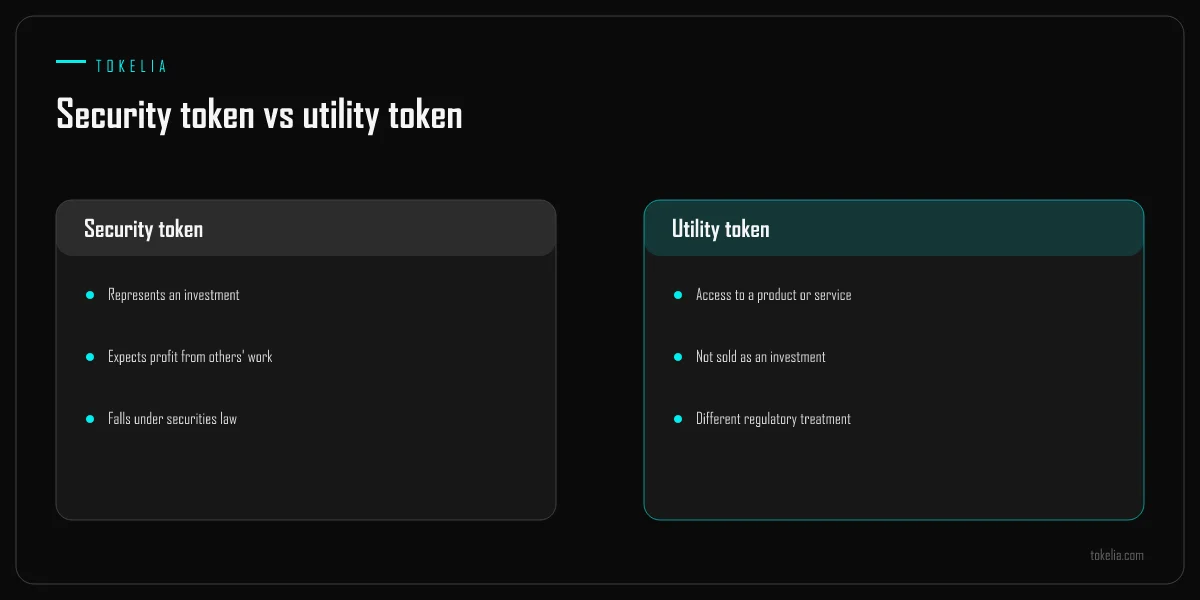
At a basic level, a security token represents an investment: a claim on profits, equity, debt, or a share of an underlying asset, issued in digital form on a blockchain. A utility token, by contrast, is designed to be consumed: it unlocks access to a platform, a service, a discount, or a function within a protocol, rather than representing an ownership or profit-sharing interest.
The distinction matters because it decides which body of law applies. Securities regulation exists to protect investors who are relying on someone else’s efforts for a return, so tokens that fit that description tend to inherit disclosure, registration, and investor-protection obligations. Utility tokens, when they genuinely function as access or usage tools, are usually treated outside that framework, though they can still trigger consumer protection or anti-money-laundering rules. None of this is fixed by a token’s ticker or its smart contract standard: two tokens built on the same chain, using the same code, can land in different buckets depending on how they are sold and what buyers are told to expect.
A security token is a digital representation of an investment: a tokenized equity stake in a company, a tokenized debt instrument or bond, a token representing a share of real estate or another income-producing asset, or a token entitling the holder to a share of profits from a fund or project.
What ties these together is the expectation the holder is buying into: a financial return that depends substantially on the work of someone else, whether a company’s management team, a fund manager, or a project’s operators. That expectation, more than the underlying technology, is usually what pulls a token into securities treatment.
Compliant security tokens are commonly built on standards designed for regulated transfers rather than open, permissionless movement. ERC-3643, for example, pairs each token with an on-chain identity (ONCHAINID) and a compliance contract that checks every transfer against eligibility rules before it settles. We cover how that works in detail in our guide to ERC-3643 (T-REX) explained.
A utility token grants access rather than ownership. Common examples include a token that pays for compute or storage on a network, a token that unlocks a tier of features in an application, a loyalty or rewards token redeemable inside a platform, or a governance token used to vote on protocol parameters without a profit-sharing claim attached.
The test that usually separates a genuine utility token from a security token dressed up as one is whether holders are buying it to use it now, or buying it to profit from someone else’s future efforts. A token that functions on a live network on day one, priced for consumption rather than speculation, looks different from a token sold as a pre-launch promise of future value driven by a team’s work.
Plenty of tokens sit in a grey zone, especially early in a project’s life when the network is not yet live and the token’s main use so far has been fundraising. That grey zone is exactly why classification should be checked deliberately rather than assumed.
Across many jurisdictions, regulators and courts lean on a version of the same general idea to separate an investment from a mere purchase: is there an investment of money, in a common enterprise, with an expectation of profit, derived mainly from the efforts of others? When all four elements are present, the arrangement tends to be treated as an investment contract, and the token representing it as a security.
This is a general framework, not a checklist you can apply mechanically, and it is not legal advice. Different jurisdictions phrase the test differently, weigh the elements differently, and some markets use entirely separate frameworks for digital assets. Whether a specific token meets the test in a specific country is a legal determination made by regulators or courts, not something a whitepaper or a marketing page can settle on its own.
What the framework is useful for is orientation. If a token is sold with promises of price appreciation driven by a team’s roadmap, and buyers are pooling money into a shared project rather than paying for something they can use immediately, that is the shape of an investment contract, and it is worth planning for security-token treatment until a qualified opinion says otherwise.
Classification is not an academic exercise; it decides which rules apply to the entire life of the token, from the first sale to every transfer after it.
If a token is treated as a security, issuers typically face registration or a qualifying exemption before any public offering, ongoing disclosure obligations to investors, restrictions on who can buy (often requiring accredited or qualified investor status in some markets), and transfer restrictions enforced at the smart-contract level so the token cannot move to an ineligible wallet. KYC and AML checks on both issuance and secondary transfers are close to universal in this category.
If a token functions as a genuine utility token, the compliance load is usually lighter on the securities side, but it rarely disappears entirely: payment rules, consumer protection law, and anti-money-laundering obligations can still apply. For the layer of licenses that typically sits underneath either type of token program (money transmission, MSB registration, EMI, and similar authorizations), see our guide to crypto and fiat licensing: MSB, EMI and MiCA.
Getting the classification wrong is expensive twice over: either you over-build compliance you did not need, or you under-build it and expose the project, its holders, and its team to enforcement risk. Neither mistake is cheap to unwind after tokens are already circulating.
Real-world asset (RWA) tokenization, representing real estate, private credit, invoices, or fund interests as on-chain tokens, is one of the fastest-growing use cases in the space, and it typically produces security tokens rather than utility tokens. The reason follows directly from the test above: buyers of a tokenized real estate interest or a tokenized credit fund are pooling money into an asset managed by someone else, expecting a financial return from that management, which is the profile of an investment contract almost by construction.
This does not mean every RWA project is treated identically everywhere, and it is not a substitute for a jurisdiction-specific opinion. It does mean teams building RWA products should plan from day one for security-token infrastructure, including identity-linked compliance and investor eligibility checks, rather than retrofitting them after a token has already been distributed. Our practical walk-through on how to tokenize real estate covers what that infrastructure looks like end to end, and the broader picture sits in our pillar guide to real-world asset tokenization.
| Security token | Utility token | |
|---|---|---|
| Purpose | Represents an investment or ownership-like interest | Grants access to a product, service, or network |
| Investment expectation | Holders typically expect profit from others’ efforts | Holders typically pay for use, not for profit |
| Common regulatory treatment | Usually treated as a security | Usually treated outside securities law, though other rules can still apply |
| Typical compliance layer | KYC, transfer restrictions, offering registration or exemption | Standard consumer and platform rules, generally fewer transfer restrictions |
| Example | Tokenized equity, debt, real estate, or fund interests | Access credit for a service, in-app rewards, or governance without a profit claim |
The pattern above holds in general, but a token can carry features from both columns at once, and that balance is often exactly what a legal opinion is weighing.
Because classification is a legal determination that varies by jurisdiction, the only reliable way to get it right is to get a formal opinion from qualified counsel in every market where you plan to offer the token, before the first sale rather than after. A few practices make that process faster and cheaper:
None of this replaces legal advice, and nothing here should be read as a legal or investment opinion on any specific token. It is general information meant to help teams ask the right questions before talking to counsel, not a substitute for that conversation.
Tokelia is the full-stack infrastructure to launch a fintech or a tokenization platform in Latin America: virtual accounts, unified crypto-and-fiat rails, local payment rails (PIX, SPEI, Bre-b) alongside ACH, Wire, FedNow, SEPA and FPS, card issuing and real-world asset tokenization, behind one API, with a non-custodial architecture and compliance built into the base stack. Money services are provided by Tokelia LLC, registered as a Money Services Business with FinCEN, and regulated banking is delivered by licensed institutions, so you can launch under your own brand while the hard-to-change parts are already solved.
If you are weighing where a token you are building fits on this spectrum, talk to our team and we will help you map the infrastructure that either path requires.
A security token represents an investment-like interest, such as equity, debt, or a share in an asset, and holders generally expect a financial return from someone else's efforts. A utility token grants access to a product, service, or network, and holders typically acquire it to use that function rather than to profit from a team's work. The distinction is a general framework, not a fixed rule, and the final classification depends on facts and on the jurisdiction involved.
Most stablecoins are designed to hold a stable value rather than to represent an investment or a redeemable service, so they typically do not fit neatly into either category and are usually addressed by separate payment or e-money rules instead. Some stablecoin-like structures can carry investment characteristics depending on how they are issued and marketed, so the classification still needs to be checked case by case rather than assumed.
No. ERC-3643 is a technical standard for issuing and transferring tokens under on-chain identity and compliance checks; it does not by itself determine whether a token is a security. Teams issuing tokens that already qualify as securities often choose ERC-3643 because it supports the eligibility checks and transfer restrictions that security-token compliance usually requires, but the classification comes from what the token represents, not from the standard it is built on.
Regulators and courts in each jurisdiction make that determination, generally by applying securities law to the specific facts of how a token is structured, sold, and used. A whitepaper, a website, or a project's own label for its token carries no legal weight on its own; what matters is the substance of the arrangement, which is why an early opinion from qualified local counsel is the only reliable way to know where a specific token stands.
Yes, in principle. A token's classification follows its structure, marketing, and actual use, and if those change materially, for example a project starts promoting price appreciation instead of access to a live service, the analysis can shift. Because reclassification carries real compliance consequences, it is worth revisiting the analysis whenever a token's use case, marketing, or transfer mechanics change in a meaningful way, rather than assuming the original classification holds forever.
Topics
Written by
DanielFull-Stack Developer, Tokenization
Daniel is a full-stack developer at Tokelia, working on the tokenization stack. He writes from the build side about how real-world assets move on-chain (real estate, receivables, agribusiness), the standards that keep it compliant (ERC-3643, KYC) and how a team can launch a tokenization platform without building the infrastructure from scratch.
Tell us your use case and we’ll point you to the right layer: infrastructure, tokenization or Yakopay.
We use essential cookies to run this site and, only with your consent, analytics cookies to measure traffic. You can change your choice anytime. Cookie Policy