PLAYBOOK
A 90-Day Plan to Launch Your Fintech MVP
A week-by-week playbook to launch a fintech MVP in 90 days, covering the regulatory perimeter, licensing, capital, core build, KYC/AML and a controlled launch.
 By Lucía 10 min read
PLAYBOOK
A week-by-week playbook to launch a fintech MVP in 90 days, covering the regulatory perimeter, licensing, capital, core build, KYC/AML and a controlled launch.
By Lucía 10 min read Most teams that set out to launch a fintech treat the 90-day question as a purely engineering one. It is not. The MVP you can build in a quarter is limited far less by code than by two things that are slow to change: your regulatory perimeter and your custody model. Get those right early and the build compresses. Get them wrong and no amount of engineering saves the timeline.
This is a concrete, phase-by-phase plan to reach a production MVP in 90 days. It assumes you integrate regulated rails rather than building them from scratch, which is the only realistic path to that timeline. For the architecture behind it, read the companion guide on how to build a crypto and fiat payment platform. Here we focus on sequencing: what to do, in what order, and what to decide before you write code.
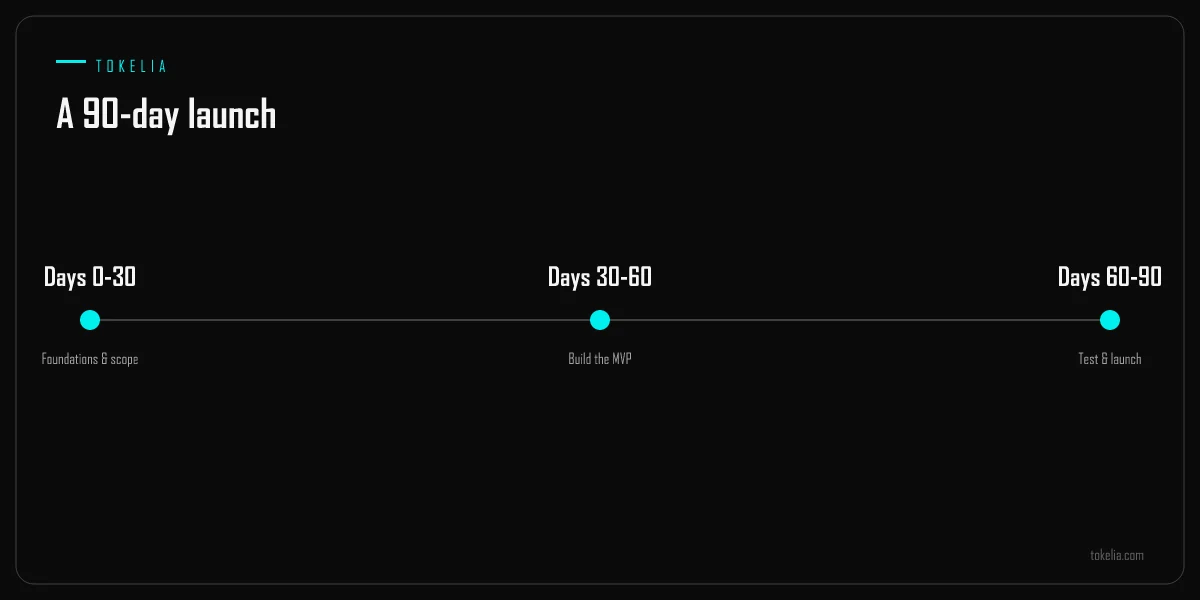
A production MVP in under 90 days is realistic for a focused team using API-based infrastructure, but only if the regulated parts ride on licensed partners. The three variables that move the date are product scope, the number of markets, and whether you need your own authorization. Applying for your own license is measured in months, sometimes over a year, and runs on a separate clock from your build. The plan below assumes you launch on partner licenses first and pursue your own authorization in parallel if your model requires it.
Before anything technical, write down exactly what your product does and who touches the money. Your regulatory perimeter is defined by one question: do you ever control customer funds? If you hold, convert or transmit customer money, you are inside money-transmission and safeguarding rules. If users keep control of their own funds and approve every movement (a non-custodial model), your surface shrinks and your licensing conversation changes.
Decide four things this week:
If you are unsure which custody model fits, the custodial versus non-custodial comparison walks through the tradeoffs.
Your regulatory path is the single biggest determinant of cost and timeline, so resolve it before you build. In most markets you have three broad options, and they are not mutually exclusive.
| Path | What it means | Time to launch | Best when |
|---|---|---|---|
| Ride partner licenses | You operate as an agent of licensed institutions that hold the regulated activity | Weeks to a few months | You want speed and a lean start, and your model is non-custodial or thin on custody |
| Get your own authorization | You apply for a license (for example an e-money or payment-institution authorization) | Many months, sometimes over a year | You need full control of the regulated activity or partner routes do not fit your market |
| Hybrid | Launch on partner licenses now, pursue your own authorization in parallel | Launch in weeks, authorize later | You want to be live while building toward independence |
Where your model requires an authorization, the category matters. Many markets separate the activity of issuing electronic money and moving payments from the activity of connecting investors with borrowers. In Mexico, for instance, its fintech law defines distinct figures for each: an electronic-payment-funds institution for e-money and payments, and a collective-financing institution for crowdfunding. Different activity, different license, different rules. Pick the one that matches what you actually do, and confirm the classification with counsel because it varies by market.
For a deeper map of registrations across regions, see licenses to move crypto and fiat: MSB, money transmitter, EMI and MiCA.
Set your budget once the regulatory path is clear, because the path changes the numbers by an order of magnitude. Applying for your own license usually requires minimum capital set by the regulator, plus legal, audit and ongoing supervision costs. Launching on partner licenses trades some recurring fees for far lower upfront capital and a much shorter path to revenue.
Build your budget around these buckets:
Do not treat minimum capital figures you find online as fixed. They differ by market, by activity, and change over time, so model your own numbers with counsel and your providers.
The core is smaller than most teams expect, because the hard, undifferentiated parts are integrated rather than built. Your minimum viable stack has four pieces: a unified payments API, a wallet and custody layer, a compliance engine, and an operations dashboard.
Treat crypto and fiat as one ledger from the first commit. That single decision lets you launch with fiat and add stablecoin rails later without re-architecting. Wire webhooks for every transaction event and make every write idempotent so no event is processed twice and your ledger stays auditable. A create-payment call should look roughly like this, with an idempotency key protecting you against retries and duplicates:
curl -X POST https://api.yourprovider.com/v1/payments \
  -H "Authorization: Bearer $API_KEY" \
  -H "Idempotency-Key: 4f1a9c2e-7b3d-4e6a-9f21-8c0d5b2a1e77" \
  -H "Content-Type: application/json" \
  -d '{
    "amount": "250.00",
    "source_currency": "MXN",
    "settlement_currency": "USDC",
    "beneficiary": { "type": "bank_account", "rail": "ach", "account_ref": "acct_9f2b" },
    "metadata": { "order_id": "ord_10432" }
  }'
The provider then posts asynchronous updates to your webhook as the payment moves through states (created, screened, settled or failed), and your ledger reconciles against those events. If you want the reasoning behind this design, the Banking-as-a-Service guide explains how the regulated activity sits behind the API you integrate.
Compliance belongs inside the product flow, not bolted on after launch, because retrofitting it means redesigning flows and migrating data. Build KYC/KYB into onboarding as a step users cannot skip, run sanctions and PEP screening at onboarding and on every transfer, and monitor transactions with rules you can configure per market.
If you move crypto, add wallet screening and travel-rule data exchange where thresholds require it, attached to the transfer automatically so settlement does not slow down. The mechanics of all of this are covered in how KYC and AML work for crypto and fiat payments. The principle for the plan is simple: if a check is not in the flow by day 65, it will be far more expensive to add in month six.
With the core and compliance live, add the rails that make the product useful and then attack the failure paths. Card issuing that spends directly from the balance, cross-border payouts to local rails, and on and off ramps between crypto and fiat are the common additions at this stage.
Then test what breaks in production, not what works in a demo: reversals, sanctions hits, network congestion, partial failures and duplicate events. Stand up the operations dashboard so your team can manage settlements, alerts and reports without touching the database. This is where a prototype either becomes a platform or reveals that it never was one.
Launch to a closed pilot with real users and real money at low limits before you open the doors. The pilot exists to prove three things under real conditions: reconciliation holds, settlement timing is predictable, and the audit trail is complete. Only when those hold do you raise limits and widen access.
Keep the perimeter narrow for the pilot, one market and a short list of flows, so that any issue is easy to isolate. A clean pilot is worth more than an impressive feature list, because it is the evidence a partner bank or regulator will actually ask to see.
Here is the full sequence in one view, which doubles as the checklist to run against each week.
| Phase | Days | Focus | Exit criteria |
|---|---|---|---|
| Scope | 1 to 10 | Model, flows, markets, custody | Perimeter written and agreed |
| Regulatory path | 11 to 25 | Partner licenses, own authorization or hybrid | Path chosen, classification confirmed |
| Budget | 20 to 30 | Capital, costs, runway | Funded plan with realistic numbers |
| Core build | 31 to 50 | API, ledger, webhooks, idempotency | One real flow end to end |
| Compliance | 51 to 65 | KYC/KYB, screening, monitoring | Checks live inside the flow |
| Rails and hardening | 66 to 80 | Cards, cross-border, failure paths | Unhappy paths tested |
| Controlled launch | 81 to 90 | Closed pilot at low limits | Reconciliation and audit trail hold |
Tokelia is the infrastructure for programmable money: virtual accounts, unified crypto-and-fiat rails, card issuing, cross-border payments and stablecoins behind one REST API, with SDKs, webhooks and idempotency built in, a non-custodial architecture, and compliance in the base stack rather than sold as add-ons. Money services are provided by Tokelia LLC, a company registered as a Money Services Business with FinCEN, with regulated banking delivered by licensed institutions, so you can launch under your own brand and lean on partner licenses for the regulated parts while your team builds the product.
If you are scoping a 90-day launch, the fastest way to pressure-test this plan against your own model is to walk a real flow with our team. Talk to us and get a sandbox key.
With API-based infrastructure and a non-custodial model, a team fluent in REST APIs can reach a working integration in a few weeks and a production MVP in under 90 days. The technology is rarely the bottleneck. Your real timeline is set by product scope, the markets you serve and how long any required authorization takes in those markets, which can run months on its own.
Four things in parallel: a defined product and business model, a clear regulatory perimeter (who controls the funds and in which markets), the technology stack (accounts, ledger, payment rails, KYC/AML) and enough capital to cover setup, compliance and runway. You do not need to build the regulated rails yourself if you operate through licensed partners, which is how most teams compress the timeline.
Start from the business model and the regulatory perimeter, not the code. Decide your custody model, map which regulated parts you can ride on partner licenses, then integrate a unified payments API, an embedded compliance engine and an operations dashboard. Build only the parts that differentiate you and integrate the undifferentiated infrastructure.
It depends entirely on who controls the funds and where your customers are. If you hold, convert or transmit customer money you generally need registrations or a license in each market (for example an MSB registration in the US, an EMI or payment-institution license in Europe, or an authorization under a local fintech regime). If you are non-custodial and act as an agent of a licensed institution, much of that surface can ride on partner licenses. Confirm your specific case with fintech regulatory counsel.
Cost varies widely by market and by whether you seek your own authorization or launch on partner licenses. Budget for legal and regulatory work, incorporation, minimum capital where a license is required, technology integration, and recurring compliance and audit. The partner-license route trades some ongoing fees for far lower upfront capital and a shorter path to launch. Model your specific numbers with counsel and providers.
They are two different regulated activities. An electronic-money or payment institution issues stored value and moves payments (accounts, wallets, transfers), while a crowdfunding or collective-financing institution connects investors with borrowers or projects. In several markets, including Mexico under its fintech law, these are distinct authorizations with different rules, capital and supervision, so you choose the one that matches your actual activity.
Yes, if you architect for it from the start. Treat crypto and fiat as one ledger on day one so you can enable stablecoin and crypto rails incrementally without re-architecting the core. Bolting crypto on after launch is far more expensive than designing for both up front.
Topics
Written by
LucíaCompliance & Regulatory
Lucía covers compliance and regulation at Tokelia. She writes about the licensing, KYC/AML and travel-rule questions that come up when a fintech starts moving crypto and fiat, and turns them into decisions a founding team can act on.
Tell us your use case and we’ll point you to the right layer: infrastructure, tokenization or Yakopay.
We use essential cookies to run this site and, only with your consent, analytics cookies to measure traffic. You can change your choice anytime. Cookie Policy